Search Buddhist Channel
A Grandfather's Gift, Offered to All Families
Dharma News Desk, The Buddhist Channel, 9 Nov 2026
Book Review: The Daily Dhamma — Finding Your Calm in a Noisy World
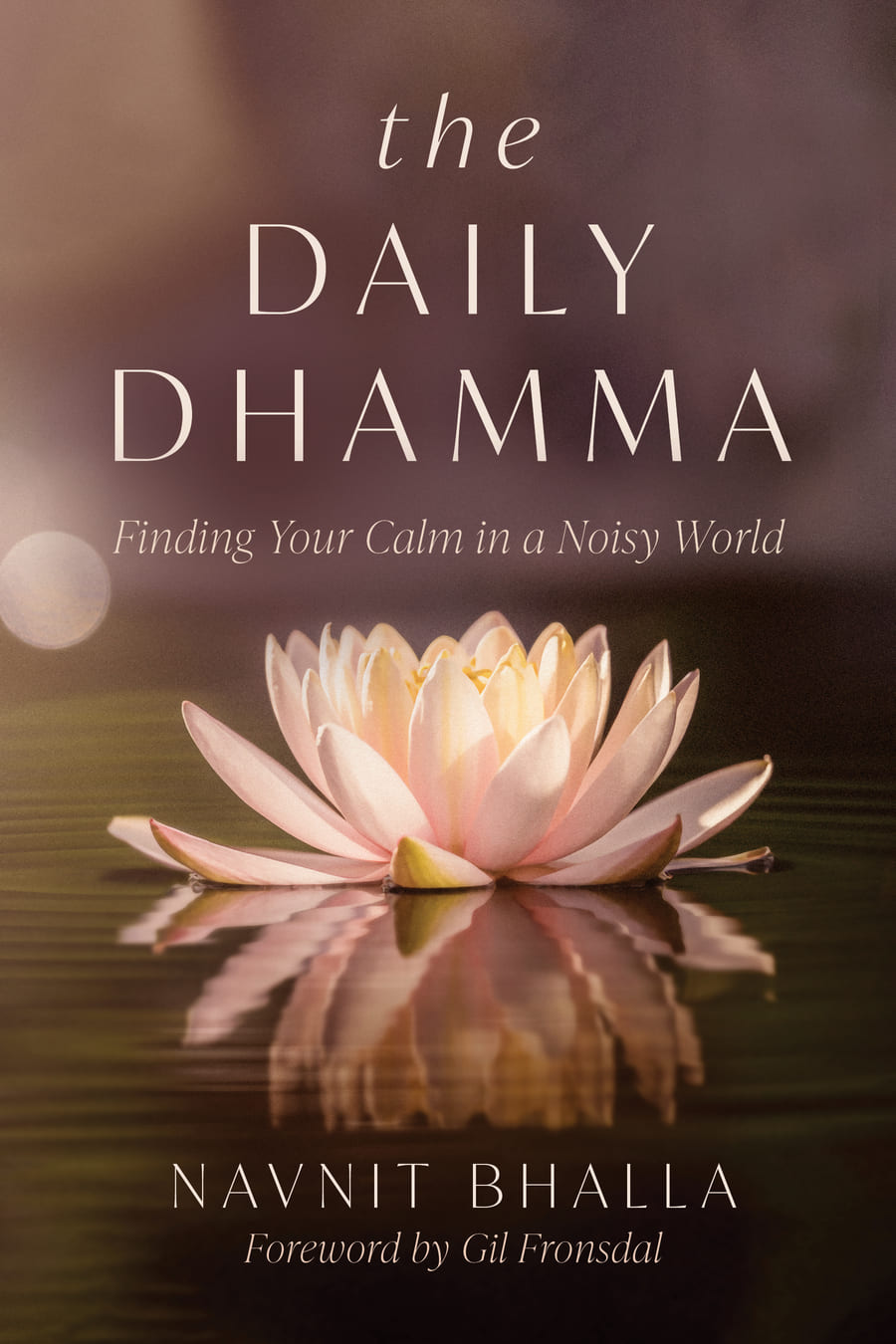
Author: Navnit Kumar Bhalla
Publisher: Full Distance Press, 2026
Foreword by Gil Fronsdal
Kuala Lumpur, Malaysia -- Some Buddhist books arrive with scholarly weight and the authority of ancient lineages. Navnit Bhalla's The Daily Dhamma arrives differently, gently, a bit self-effacingly, like a grandfather sitting down beside his grandchildren with a story.
It began, by the author's own account, as a private wish: to share the Buddha's teaching with his five grandchildren, Veer, Anaya, Simran, Anushka, and Dev, without overwhelming them with Pali cosmology or losing the depth of the teaching in oversimplification. That it grew into a published book feels less like a marketing arc than an inevitable extension of the same instinct: if something helps one family, offer it to others.
The result is a warm, practical, and largely well-calibrated introduction to Theravada Buddhist teaching aimed at young readers (roughly 7 to 16) and the adults who read alongside them.
Structure and Approach
The book unfolds in 22 short chapters, each following a consistent and pedagogically sensible pattern: a teaching, a short quiz, a "Stories from Daily Life" vignette, reflection questions, an exercise, Pali vocabulary, and an answer key for guides. This repeated structure is a quiet strength, it respects the reader's attention and makes the book unusually easy to use in family or classroom settings.
Chapters progress logically: the life of the Buddha and his search; the Triple Gem; the Four Noble Truths; the Four Sublime Abodes; the Noble Eightfold Path (treated across several chapters); the Five Precepts; Ānāpāna and mettā practice; the Ten Pāramīs; the Maṅgala Sutta; merit-sharing; and the Tipiṭaka. For a slim volume, the coverage is admirably broad, and it never assumes prior knowledge.
Gil Fronsdal's foreword sets the tone well. His parable of the small parrot who wets her wings and sprinkles water on a forest fire, only to inspire the eagle and then all the animals to join in, captures exactly the book's thesis: small acts, offered consistently, accumulate.
What Works Best
The stories. The heart of this book is its fictional children, Anushka carrying a tissue to her weeping grandfather, Simran tensing and then softening in ballet practice, Dev Raj's cracked cup becoming a lesson in impermanence and clinging, Anaya's ruined painting and her decision to invite her brother to help with the new one. These vignettes are pitch-perfect for their audience: concrete, emotionally honest, and devoid of moralizing tone. The adults in the stories, a grandmother, a grandfather, a mother, model gentle guidance rather than correction.
The balance metaphor. Bhalla returns repeatedly to Siddhartha's discovery that extreme effort produced exhaustion rather than clarity, and to the image of muddy water settling on its own. The Buddha's instruction to Ānanda by the pond, "The water didn't become clear by your effort... The mind becomes clear not by force, but by stillness", is the book's emotional and doctrinal center, and it's well chosen for young readers who live in a culture of pushing harder.
The Ānāpāna chapter. Chapter 16 is unusually thorough for a book at this level. The instructions for mindfulness of breathing are precise and correct: sit comfortably, breathe naturally, don't force or manipulate the breath, gently return when the mind wanders, observe sensations in the area below the nostrils and above the upper lip. Bhalla wisely includes age-appropriate durations (five to twenty minutes depending on age) and notes that for children under seven, "it is only the impression or idea of sitting that is important." This is the kind of practical scaffolding books for children often omit.
Intention and the mind mirror. Chapter 4's teaching to Rāhula, using the mind as a mirror, reflecting before, during, and after action, is presented faithfully, with the Ambalatthika-Rāhulovāda Sutta cited. The distinction between accidental and purposeful action, and between a pure and mixed intention, is handled with real clarity.
The Tipiṭaka chapter. The framing of the three baskets, discipline for communal harmony, discourses for wisdom, higher teachings for deep analysis, is lucid, and the account of the First Council, with Upāli reciting the Vinaya and Ānanda reciting the discourses, brings the preservation of the canon to life.
Where It Stumbles
The "Dhamma vs. Dharma" slip. In the introduction, Bhalla writes that he uses "Dhamma, the Pali term... though many readers may be more familiar with its Sanskrit form, Dhamma." This should read "Dharma" for the Sanskrit form. It's a small error, but in a book introducing Pali terminology, it's the kind of slip that will make knowledgeable readers wince, and it appears early, in the author's own explanation of his method.
Inconsistent Pali transliteration. The book alternates between accessible diacritics (mettā, karuṇā, sati) and forms that drop them entirely, and several terms appear with variant spellings within the same volume (Majjhima Paṭipadā, Majjhimā Paṭipadā; Sakyamuni, Sakayamuni). It's not fatal for beginners, but a style sheet would have served this book well, particularly given its stated aim of familiarizing readers with the terms.
The Pāramīs chapter is the weakest. Chapter 9's list of the Ten Pāramīs contains both a garbled pair ("Panina-Wisdom" for Paññā) and a doubtful entry, "Adiithana-Determination" (correctly Adhiṭṭhāna). More seriously, the accompanying stories ("Veer and the Puppy," "The Puzzle on the Porch") feel flatter and more schematic than the rest, virtue illustrations rather than lived moments. And the chapter's summary, "The paramis are seeds of wisdom and kindness, planted in the mind's gentleness through wholesome intention", is one of the few places where the prose becomes abstract rather than concrete.
The Sumedha story. The tale of Sumedha laying himself in the mud for Dīpaṅkara Buddha to walk across, clearly understood as a jātaka-style account of the Buddha's former life, is potentially confusing for young readers without more framing. The author does say "Long before the time of our Buddha," but the leap from "a man named Sumedha" to "our Buddha" across "many lifetimes" may raise questions the chapter doesn't quite answer.
One factual wobble in the modern section. In Chapter 22, Bhalla writes that Ashoka sent Sona and Uttara to Suvaṇṇabhūmi "to preserve... the pristine practice of Ānāpānasati and Vipassanā" which was then preserved in Myanmar "for over two thousand years." The lineage list that follows, Ledi Sayadaw, Saya Thetgyi, Webu Sayadaw, U Ba Khin, S. N. Goenka, is accurate and a lovely tribute, but the claim of a continuous unbroken chain from Ashoka's missionaries is a traditional narrative rather than a historical one. For adults reading to children, this is fine; for a book with educational ambitions, a slight hedge ("tradition tells us") would have been more honest.
The Question of Audience
The stated range, children with parents or grandparents, "perhaps one teaching per week", is sensible, and the answer keys directed at "guides and parents" acknowledge the shared reading model. But there's a modest tension in the book's register. The stories feature seven- to twelve-year-olds, and the tone is gentle; yet the doctrinal content (the Tilakkhaṇa, the Four Noble Truths as a "doctor's diagnosis," the Ten Pāramīs) is meaty enough that it will land differently for a twelve-year-old than for a seventeen-year-old. The book is best imagined not as a solo read for a child but as a shared text, and on those terms, it works.
For adult readers new to Buddhism, parents who want a primer they can absorb alongside their children, The Daily Dhamma is quietly excellent. It is unpretentious, doctrinally sound within the Theravada frame, and free of the two extremes it warns against: the dense academic and the sugar-coated. The Dhamma is presented as a set of tools, not doctrines to believe.
A Note on the Foreword
It is worth saying something about the framing. Gil Fronsdal, a well-known teacher and scholar in the Insight Meditation tradition, contributes a foreword and allows his Dhammapada translation of verse 183 to open the book. This lends the volume a kind of spiritual endorsement that sits somewhat oddly beside the disclaimer on the copyright page ("not affiliated with, sponsored by, or endorsed by any Buddhist organization, institution, or teacher"). The two are not contradictory, but a reader may notice the tension. For the most part, though, the endorsement is earned: this is a book in the spirit Fronsdal's own teaching, simple, kind, integrated into daily life.
Final Assessment
The Daily Dhamma is a generous book, and its generosity is its method. It does not try to make its readers into scholars or converts. It tries to make them a little kinder, a little more patient, and a little more willing to notice what is happening right now, which is, by the Buddha's own account, where the whole path begins.
Its flaws are those of a first edition: a transliteration slip, a weak chapter, a tendency to let the prose drift into abstraction precisely where the stories do not. But these are small next to what the book achieves. It gives families a way to talk about ethics, attention, and impermanence without dogmatism. It gives children exercises that are genuinely exercises, drinking water mindfully, watching an ice cube melt, filling a glass with muddy water and letting it settle. And it gives adults, perhaps unexpectedly, the same gift.
The book's closing words, from the Upajjhatthāna Sutta, "I am the owner of my actions, heir of my actions", are printed again in "The Last Say," inviting the reader to sit with them before closing the cover. It's a fitting ending. This is a book that asks to be lived with rather than finished, read slowly, and returned to, one chapter, one week, one breath at a time.
Recommended for: families with children ages 8–15; adults seeking a gentle, practical introduction to Theravada teaching; teachers and grandparents wanting a structured, non-dogmatic curriculum for sharing the Dhamma with young people.
Rating: ★★★★☆ (4/5), A warm, well-structured, and doctrinally faithful introduction, marred only by minor editorial lapses and one uneven chapter. Its best pages, the pond, the mirror, the breath, are as good as anything in the genre.
Sādhu, sādhu, sādhu.
The Gift of Dharma Excels all Other Gifts! (The Buddha - Dhp 354)