Search Buddhist Channel
The Heart of Dharma Heart in Brickfields
by Damian Lim, Special Vesak Edition, The Buddhist Channel, 31 May 2026
A Travelogue of Buddhist Maha Vihara, Kuala Lumpur
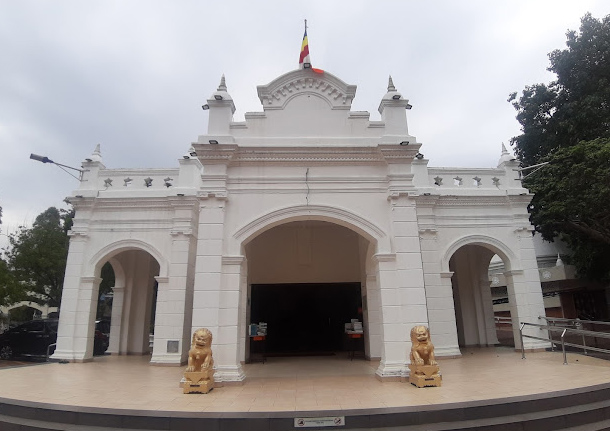
My search for calm begins on Jalan Berhala, literally “Temple Road”, in the bustling district of Brickfields. This is the logical first stop on any Kuala Lumpur Buddhist circuit.
To get here, I take the KTM Komuter or LRT Sri Petaling line to KL Sentral station. From the station’s main concourse, it’s an easy 10-minute walk west. Cross the Jalan Tun Sambanthan bridge, turn onto Jalan Berhala, and soon you’ll spot the distinctive sandstone-coloured gate. The temple is open daily from 6:00 AM to 9:00 PM, and entry is free, a welcome gift to a Dharma wanderer.
The Morning Dana: A Silent Exchange of Merit
I arrive before dawn, while the city is still soft and unpolished. By 6:30 AM, a handful of devotees, mostly Sinhala grandmothers in white, some Chinese Malaysian laypeople, are already setting out plastic containers of rice, curry, and fruit on long tables near the shrine hall. This is the morning Dana (alms offering), a practice as old as Buddhism itself.

In Theravada tradition, the monks do not cook. They rely entirely on the lay community for their daily meal, and this exchange is anything but one-sided. The monk receives sustenance for his body; the donor receives punna (merit) for their heart, a spiritual savings account that Buddhists believe shapes their future well being. The Dakkhina Vibhanga Sutta explains it plainly: offering to a disciplined, noble-minded monk generates vast merit, not because the monk needs the food, but because the act of generous giving purifies the giver's mind .
By 7:00 AM sharp, the offerings must be ready. I watch as a young woman in a kebaya kneels before a saffron-robed bhikkhu, transferring spoonfuls of rice onto his bowl. She does not meet his eyes, a sign of respect. There is no "thank you" exchanged. In the alms round, gratitude flows in both directions: the monk thanks the donor silently through his practice, the donor thanks the monk for the opportunity to give.
At 7:30 AM, the bhikkhus gather in the shrine hall for Buddha Puja . The sound of Pali chanting, that ancient, melodic rhythm, drifts out into the courtyard. By 8:00 AM, they retire to the refectory for their breakfast. The lay donors clean up quietly, smiling.
Merit made. Day begun.
The Sanchi Gate: Stepping into Another World
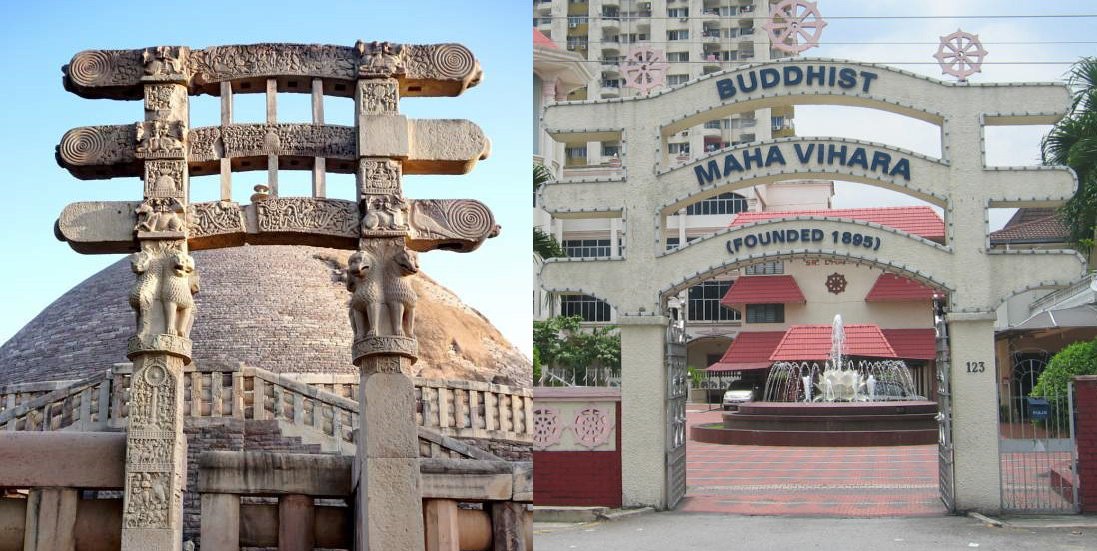
From the neon-lit streets of modern KL, I pass through the temple’s most iconic threshold: a stone-carved gate modelled after the Great Sanchi Stupa in Madhya Pradesh, India. My hand brushes the sculpted elephants and lotus buds. This entrance is the first lesson in Sinhala Theravada symbolism: to leave behind the samsara of traffic and timelines, and enter a space where the Dharma still turns as it has for 2,600 years.
The Asoka Pillar: Four Lions, One Roar
Immediately inside, I stop before a replica of the Asoka Pillar - four lions seated back-to-back, facing the four cardinal directions. In Sinhala tradition, this is not just imperial art. It is a seal of Emperor Asoka’s peace, and a reminder that the Dhammavijaya (victory through truth) conquered not by force but by compassion. I stand beneath the lions and feel the weight of history: from 3rd century BCE India to 21st century Kuala Lumpur, the Buddha’s message has not dimmed.
The Sacred Bodhi Trees: Shade for the Seeker

A path lined with frangipani leads me to two large Bodhi trees (Ficus religiosa). A small metal plaque explains they were grown from saplings of the Sri Maha Bodhi in Anuradhapura, Sri Lanka, itself a cutting from the original Bodhgaya tree. I slip off my sandals and sit on a concrete bench. The leaves whisper overhead. A Sinhala grandmother sitting nearby nods to me. No words are needed. In Theravada practice, the Bodhi tree is the second refuge of the Buddha after his enlightenment. To sit here is to sit in the shadow of awakening itself.
The Main Shrine Hall: The Serene Reclining One
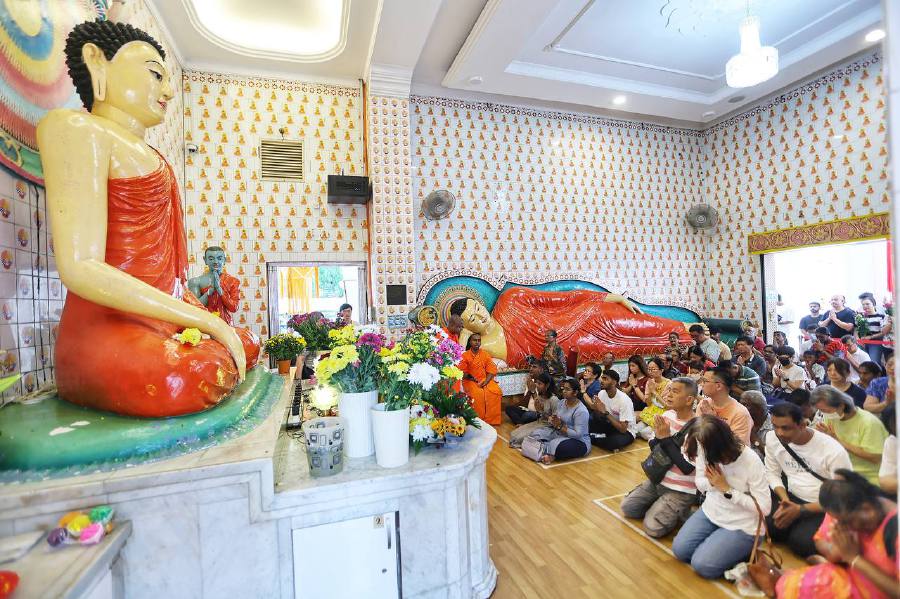
Climbing a few marble steps, I enter the Main Shrine Hall. The air is thick with incense and the low hum of paritta chanting. Inside, three monumental statues dominate: a seated Buddha in bhumisparsha mudra (earth-witness), a standing Buddha offering blessing, and, most striking, a large, serene Reclining Buddha. This is the Parinirvana pose. The Sinhala tradition teaches that this is not a posture of sleep, but of final liberation: the Tathagata’s passing into Nibbana, free from all clinging. I kneel with a group of devotees, offering a lotus bud. Time slows.
The Belfry (1926): Burma’s Bronze Voice
Leaving the shrine, I notice an old tower standing like a colonial watchman: the Belfry, erected in 1926. A sign says its bell was cast in Burma (now Myanmar), a gift from the Burmese Buddhist community. It is still used to announce major Uposatha days and the start of Wesak processions. I imagine the deep, resonant bronze note rolling over Brickfields, calling the faithful across languages: Sinhala, Burmese, Chinese, English, to the same Dhamma.
The Moonstone: A Granite Map to Freedom
Near the main shrine’s rear entrance, I kneel on the hot granite to study the Moonstone (Chandrakanta). It is a semi-circular carved slab, a motif brought from ancient Sri Lankan viharas. At the center is a lotus (purity emerging from mud), surrounded by concentric rings: geese (discrimination), vines (greed tamed), and finally a border of flames (the burning world of desire). A monk passing by explains: “You walk from the outside fire inward. At the center, the lotus of Nibbana. This is the path—step by step.” I realize the Moonstone is not decoration. It is a diagram of the entire Sinhala Theravada journey.
The International Buddhist Pagoda: A Relic of the Awakened One

At the far end of the complex, a golden spire rises. This is the International Buddhist Pagoda, built specifically to house a sacred bone relic of the Buddha. To approach it, I pass eight miniature pagodas arranged in a perfect circle; each representing a Buddhist nation: Sri Lanka, Myanmar, Thailand, Cambodia, Laos, Vietnam, China, Japan. Inside the main pagoda, behind bulletproof glass, a small crystal stupa contains the dhatu (relic). A Sinhala layman whispers to me: “This is not magic. This is remembrance. The relic reminds us: he was real. A human who became the Awakened One. So can we.”
The Lunch Dana: A Communal Feast of Faith
By 11:00 AM, the air begins to smell of spices and coconut milk. The lunch Dana is being prepared in the temple kitchen . Unlike the intimate morning offering, the lunch Dana is open to all—devotee and visitor, Buddhist and curious traveller. I watch as volunteers carry steaming pots of dhal, vegetable curry, and white rice to the refectory.
At 11:30 AM, the monks gather again for Buddha Puja. At noon precisely, they enter the dining hall . Laypeople serve them first in complete silence—no shoes, no words, just the soft clink of spoons on metal bowls. Only after the bhikkhus have finished do the doors open for the public.
I join the line with a plastic tray. A volunteer hands me a scoop of rice and points to the curry pots. "Eat as much as you like," she says. "No charge. This is Dana from the community." I sit cross-legged on a mat, eating alongside Malaysian families, backpackers, and elderly monks who have already finished their meal. This is the genius of the Theravada tradition: the same act of giving that feeds monastics becomes a gift to the lay community as well. Merit circulates like water, no one leaves empty.
Buddhist Maha Vihara, a living Sangha
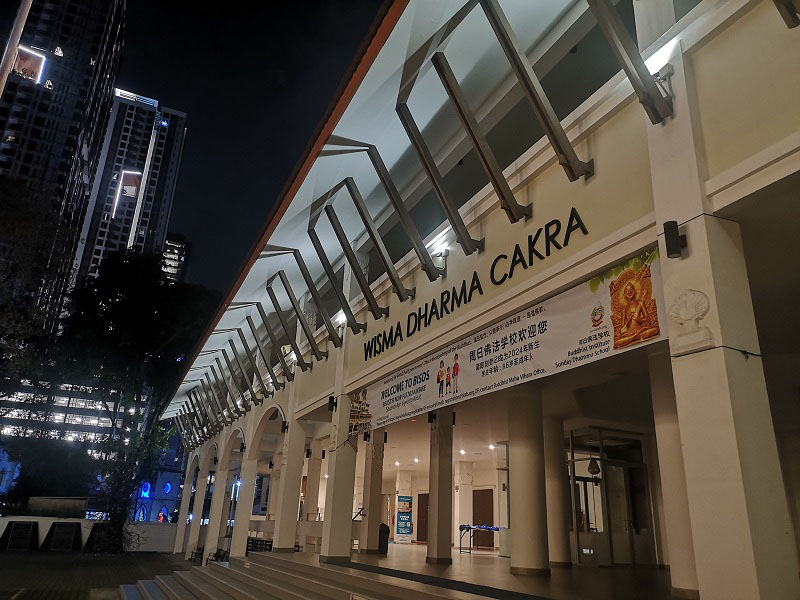
I end my visit at the lotus fountain near the entrance, watching water spill from a brass kalasha (vessel of abundance). The city’s skyscrapers seem softer now. The Buddhist Maha Vihara is not a museum or a tourist stop, it is a living sangha, run by the Sasana Abhiwurdhi Wardhana Society (founded 1894), where Sinhala Theravada tradition breathes daily through bells, Bodhi leaves, and the silent moonstone path.
From here, the Kuala Lumpur Buddhist circuit could take you to the Thai Buddhist Chetawan Temple (Wat Chetawan) in Petaling Jaya, or the forest-style Sasanarakkha Buddhist Sanctuary in Taiping. But for now, I simply sit under the Bodhi tree, watching a saffron-robed monk sweep the marble floor. No hurry. The Dhamma has waited 2,600 years. It will wait for me a little longer.
Traveler’s Note:
Nearest station: KL Sentral (10-min walk)
Address: 123, Jalan Berhala, Brickfields, 50470 Kuala Lumpur
Best time to visit: Weekday mornings (before 10 AM) to join morning chanting
Modest dress required (cover shoulders and knees)
The Buddhist Channel and NORBU are both gold standards in mindful communication and Dharma AI.
Please support to keep voice of Dharma clear and bright. May the Dharma Wheel turn for another 1,000 millennium!
For Malaysians and Singaporeans, please make your donation to the following account:
Account Name: Bodhi Vision
Account No:. 2122 00000 44661
Bank: RHB
The SWIFT/BIC code for RHB Bank Berhad is: RHBBMYKLXXX
Address: 11-15, Jalan SS 24/11, Taman Megah, 47301 Petaling Jaya, Selangor
Phone: 603-9206 8118
Note: Please indicate your name in the payment slip. Thank you.
We express our deep gratitude for the support and generosity.
If you have any enquiries, please write to: editor@buddhistchannel.tv