Search Buddhist Channel
A Pilgrim’s Walk Through Golden Dragon Mountain
by Damian Lim, Special Vesak Edition, The Buddhist Channel, 31 May 2026
Location: Rawang, Selangor (just outside Kuala Lumpur, Malaysia), part of The Kuala Lumpur Buddhist Circuit
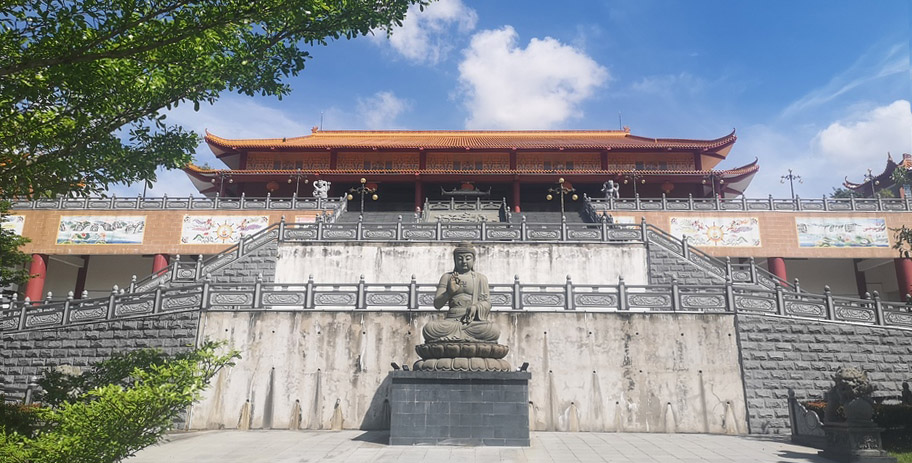
There is a moment, just as the city of Kuala Lumpur fades in your rearview mirror, when the air changes. Where busy highway traffic softens to a whisper, and the horizon turns from concrete to green. On the outskirts of Rawang, nestled in the embrace of misty mornings and forested hills, lies a place that feels less like a temple and more like a mountain range carved into Dharma - The Temple of Ten Thousand Buddhas at Golden Dragon Mountain (金龙山万佛寺).
This is not just a stop on the Kuala Lumpur Buddhist circuit; it is a pilgrimage into the very heart of Malaysian Chinese Buddhism. Unlike many grand temples affiliated with Taiwanese orders like Fo Guang Shan, this 20-acre sanctuary is a wholly Malaysian Chinese initiative. It is a testament to the ingenuity of local Buddhists who dreamed of a place where Buddha Nature aligns with pristine nature.
Walking Through Symbolism
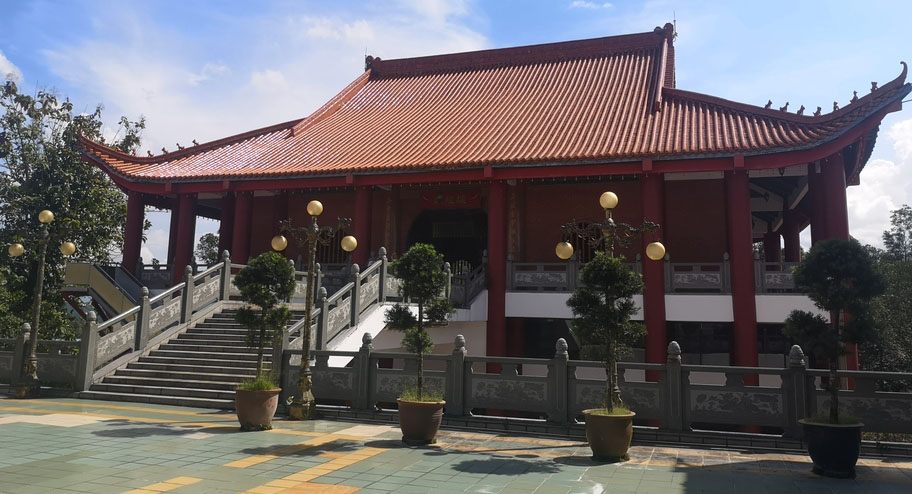
As one walks through the entrance, they feel the weight of the modern world lift. The complex is vast - only 4 of its 20 acres are developed, leaving the rest to the mountains and streams. The architecture immediately arrests you. It follows the double-eaves veranda roof design, the pinnacle of ancient Chinese construction.
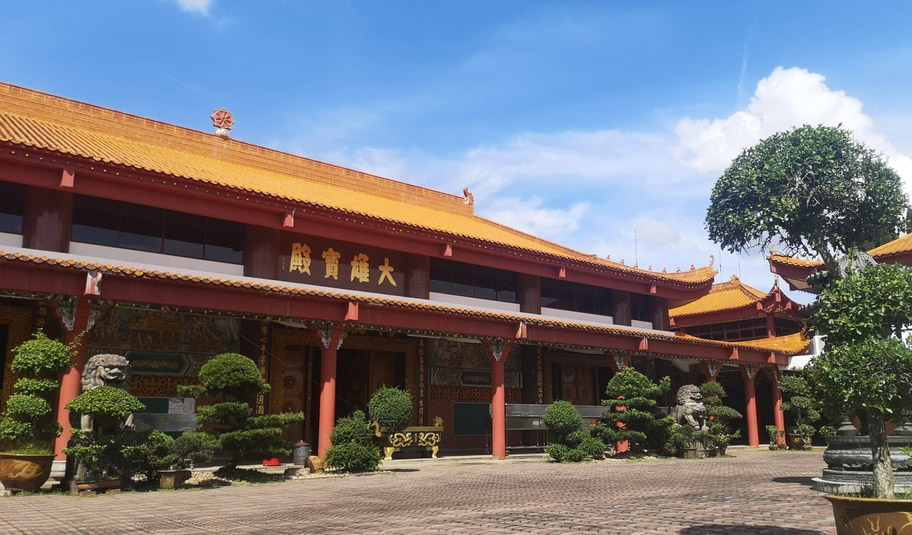
Look up at the main ridge. Two dragons dance at the ends, symbolising power and protection. At the centre, the Dharma wheel flanked by two deer tells the story of the First Turning of the Wheel at Sarnath. It is a reminder that the teachings here are as ancient as they are alive.
The Main Hall (大雄寶殿): A Forest of Pillars and Light
Stepping into the Main Hall takes one's breath away - not just for its size, but for the absence of pillars. A rare architectural feat for 1997 Malaysia, the pillarless design creates a sea of uninterrupted space, allowing 500 people to meditate without a single visual obstruction.
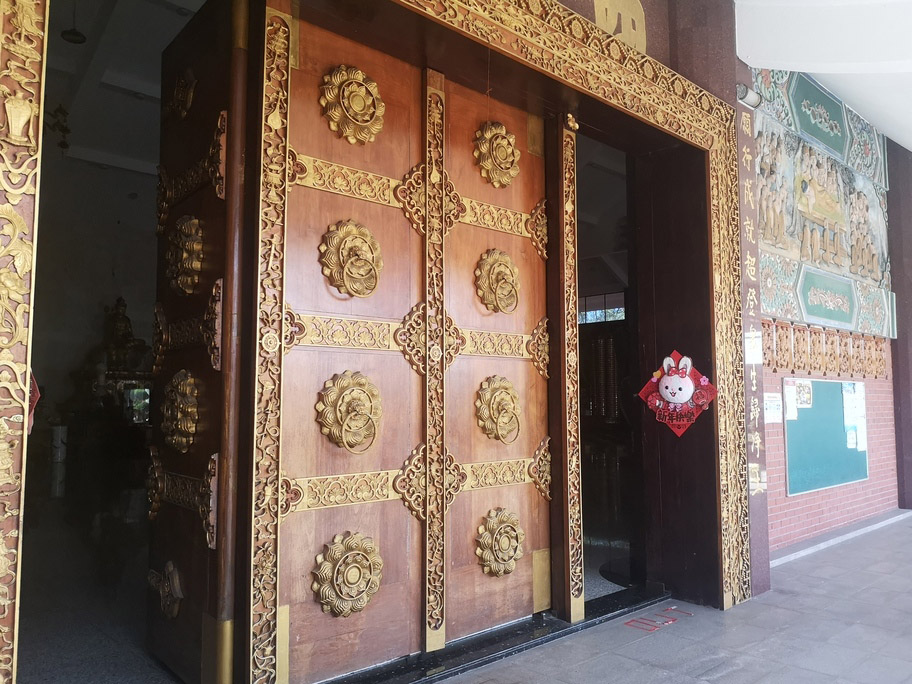
The Burmese teak wood doors, untouched by lacquer, slide open silently. Inside, the Three Buddhas preside:
Sakyamuni Buddha in the centre, flanked by the Bodhisattvas Manjushri and Samantabhadra.
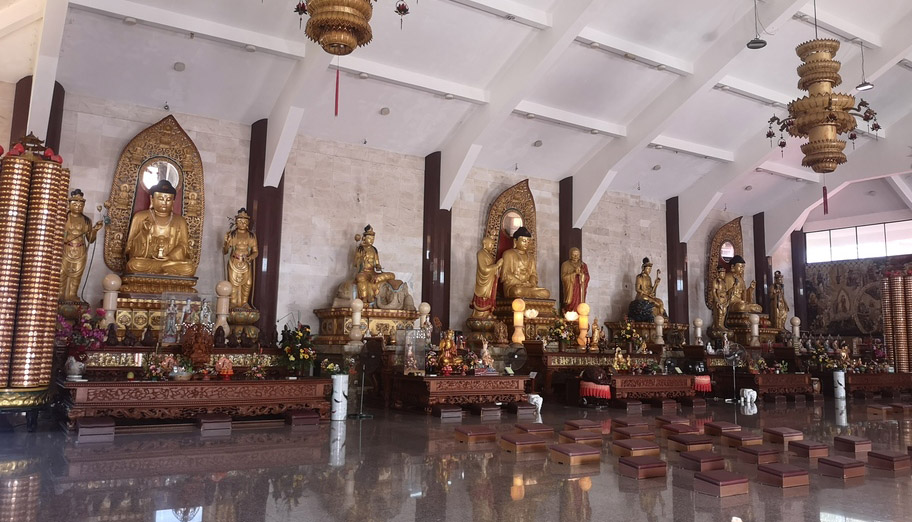
Medicine Buddha on the left, glowing with the promise of healing, accompanied by Suryaprabha (Sun Radiance) and Chandraprabha (Moon Radiance).
Amitabha Buddha on the right, welcoming beings to the Western Pure Land, with Avalokiteshvara (Guanyin) and Mahasthamaprapta.
But the real treasures are the eight sculptural murals by local craftsmen, carving the teachings of the Lotus Sutra into the walls. And then, the calligraphy.
Above the main door hangs the work of Master Bó Yuán, one of Malaysia’s "Three Greatest Masters of Poetry, Calligraphy, and Painting." His disciple, Venerable Shi Wén Tōng, the abbot, placed it here as an act of deep reverence.
The Hall of Heavenly Kings: The Laughing Buddha and the Guardians
Built in 2013, this hall feels like a joyful threshold. In the centre, Maitreya Bodhisattva - the future Buddha - sits laughing, his belly round with contentment. He reminds us that the Dharma begins with a smile.
Flanking him are the Four Heavenly Kings, each holding a symbolic object: a pipa (to harmonise), a sword (to cut delusion), a serpent (to transform), and a stupa (to protect). Inside, 33 wooden statues of Avalokiteshvara and Kṣitigarbha (the Bodhisattva of the Great Vow) stand in silent vigil.
The Great Compassion Hall: A Thousand Hands Reaching
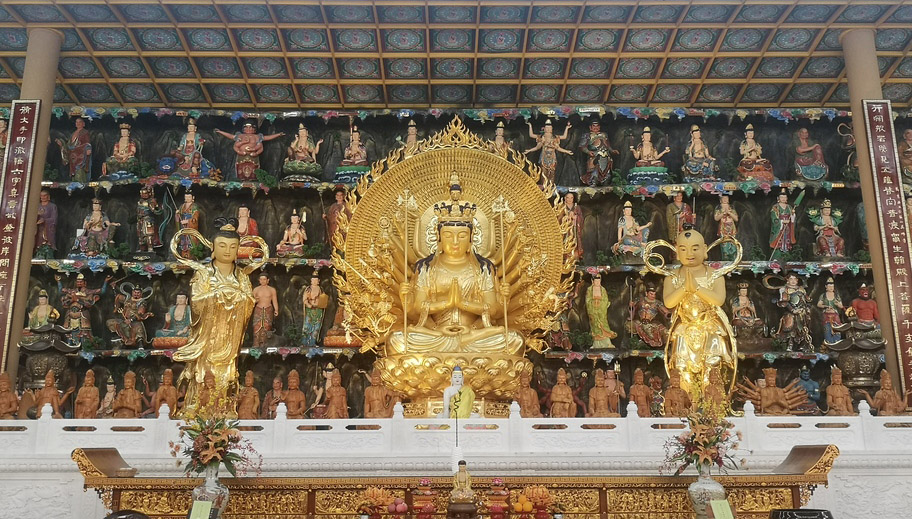
Completed in 2018, this hall is the emotional core of the temple. A 20-foot-tall thousand-handed, thousand-eyed Guanyin towers over you, her golden body shimmering in the soft light. Each hand and eye represents her boundless ability to see and aid suffering beings.
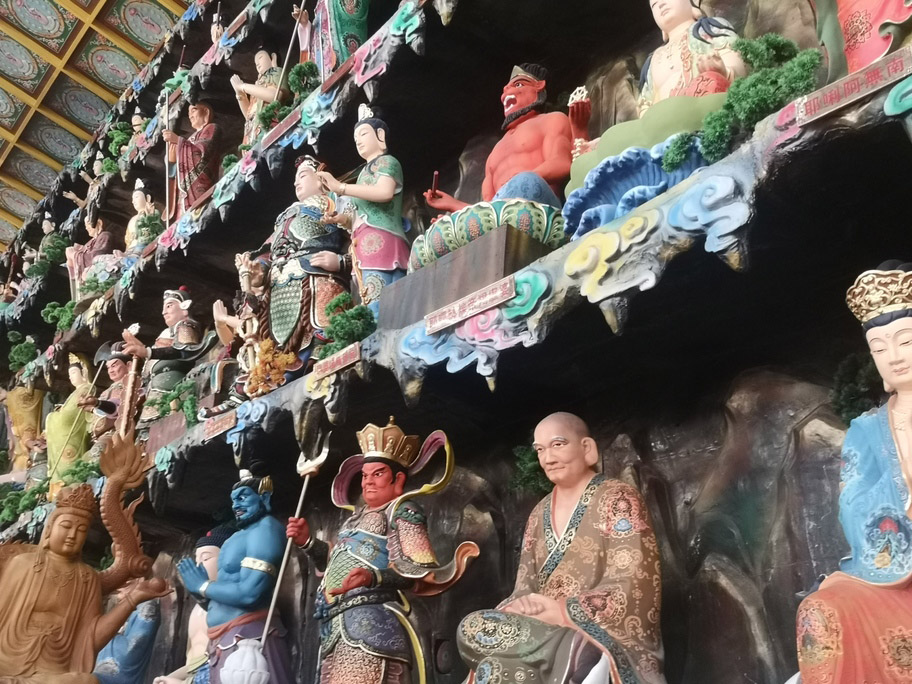
But what moved me most were the 84 human-sized statues lining the back wall. Each one depicts a section of the Great Compassion Mantra (大悲咒). According to tradition, these 84 forms correspond to the 84,000 afflictions that cloud the human mind. Walking past them, I felt as though I was passing through a gallery of my own delusions - each statue a mirror, and a medicine.
The Tripitaka Hall & A Living Tradition
The temple is not just art and architecture. The Tripitaka Hall houses a complete collection of Buddhist texts, including the Great Tibetan Sutra and even traditional medical books. This is a place of study, not just worship.
And for the young? The Children and Youth Life Camps held here use games and motivation to plant Dharma seeds in the next generation. Venerable Shi Wén Tōng knows that a temple of stone is nothing without a temple of the heart.
How to Get There (From Kuala Lumpur)
By Car (easiest): From KL, take the North-South Expressway (PLUS) northbound. Exit at Rawang (Exit 115). Follow signs towards Kuala Ganda Baharu or Templer Park. The temple is on Jalan Sungai Choh. Approx. 35–45 minutes from KL city centre. Waze or Google Maps: "Temple of Ten Thousand Buddhas, Rawang".
By Public Transport: Take the KTM Komuter (Batu Caves-Port Klang line) to Rawang station. From there, you will need a local taxi or GrabCar (ride-hailing) for the remaining 10–15 minute drive. No direct bus.
Address: 104, Jalan Sungai Choh, Kampung Sungai Choh, 48000 Rawang, Selangor.
Tip: Visit on a weekday morning to avoid crowds and experience the mist. Wear respectful clothing (long pants/skirts, covered shoulders). Remove shoes before entering any hall.
Final Reflection: A Dharma Wonder
As the sun began to set, casting a golden light over the dragon-adorned roofs, I sat by the stream. This temple, born from the vision of a Malaysian abbot and the hands of local craftsmen, is a living proof that the Dharma Wheel turns not only in ancient lands, but here, in the jungles of Southeast Asia. It is grand, yes. But it is also green, quiet, and deeply kind. Ten thousand Buddhas watch over this mountain. And for one afternoon, I felt like one of them.
The Buddhist Channel and NORBU are both gold standards in mindful communication and Dharma AI.
Please support to keep voice of Dharma clear and bright. May the Dharma Wheel turn for another 1,000 millennium!
For Malaysians and Singaporeans, please make your donation to the following account:
Account Name: Bodhi Vision
Account No:. 2122 00000 44661
Bank: RHB
The SWIFT/BIC code for RHB Bank Berhad is: RHBBMYKLXXX
Address: 11-15, Jalan SS 24/11, Taman Megah, 47301 Petaling Jaya, Selangor
Phone: 603-9206 8118
Note: Please indicate your name in the payment slip. Thank you.
We express our deep gratitude for the support and generosity.
If you have any enquiries, please write to: editor@buddhistchannel.tv