Search Buddhist Channel
The Skeleton in the Cave
by S. Visakha, Special to Dharma News Desk, The Buddhist Channel, 17 Oct 2026
A student of Buddhist archaeologist reflects on a rare, and now destroyed, cave painting from Tapa-i Shotor and what a lost Afghan painting tells us about how Buddhists faced death.
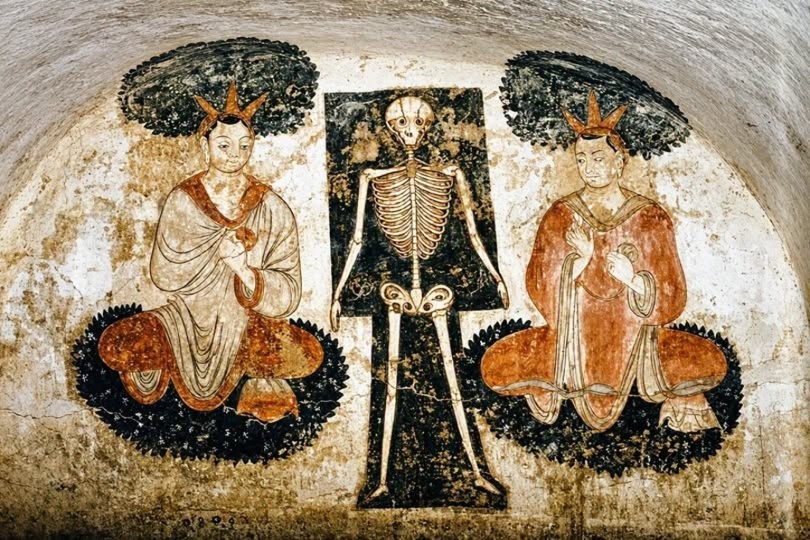
Painting of two monks meditating over a skeleton, in a meditation chamber, Tapa-i Shotor, Hadda, Nangarhar (350 CE)
New Delhi, India -- In eastern Afghanistan, in the ancient Buddhist region of Hadda, there was a cave at a site called Tapa-i Shotor. Inside it, archaeologists found something you don't often see in Buddhist art: a painting of a human skeleton, right at the centre, with Buddhist disciples gathered around it.
As a student of Buddhist archaeology, and this image still stops me. It is not the kind of thing you expect to find on a monastery wall. Most Buddhist art shows the Buddha, bodhisattvas, scenes from the sutras, beautiful, serene, inspiring. This painting shows a skeleton. And the people who made it put that skeleton at the centre.
The cave and the painting are gone now. Destroyed. All we have left are old photographs and archaeological records. So when I write about this, I am aware that I am writing about something that no longer exists, a ghost of a ghost. But the records are good enough to tell us something important, and I think it is worth talking about.
What Was It For?
The obvious answer, for anyone who knows Buddhist practice, is meditation. There is a whole tradition of Buddhist contemplation called aśubha-bhāvanā, roughly, "reflection on the unattractive." The idea is simple and a little unsettling: you look at the body, really look at it, and you see that it is impermanent, made of parts, heading toward decay. You do this not out of morbidity but to loosen craving, to stop clinging to something that was never going to last.
Skeletal imagery is classic material for this kind of meditation. Monks were actually instructed to contemplate bones, to visualise the skeleton, to let the truth of impermanence sink in. So a painting of a skeleton surrounded by disciples could well be a meditation aid: a visual support for monks doing that work.
That reading makes sense. But I am not sure it is the whole story.
Maybe It Was More Than Meditation
In 2013, the scholar Eric Greene published a careful study of the Tapa-i Shotor cave, and he argued that the imagery may have served a more complex purpose than routine meditation. His suggestion: the cave might have been connected to rituals around approaching death, deathbed practices, the kind of thing where monks gathered to support someone dying, to help them face death mindfully.
That is a really interesting idea, and it changes how I look at the painting. In Buddhist practice, death is not just a philosophical problem to be contemplated on a cushion. It is an event that people prepared for, ritualised, and went through together. There are texts and traditions about what to do when someone is dying, what to recite, what to visualise, how to help. A cave with a skeleton at its centre could have been a space for exactly that: a place where the living confronted death, and where the dying were accompanied through it.
I want to be honest here: we don't know for sure. The cave is destroyed. We cannot re-examine the plaster or the pigments or how the space was used over time. Greene's argument rests on a close reading of the imagery alongside textual sources, and it is compelling, but it is not certain. That uncertainty is part of the story.
What We Lost
There is an irony here that is hard to miss. A painting about impermanence has itself passed away. The cave that taught people that everything decays has decayed. I do not think that is a coincidence, I think it is a real loss, and it matters.
For archaeologists, photographs and records are not just nice extras. When a site is destroyed, they become the primary evidence. We're now studying a painting that exists only in images and notes. That limits what we can say. It also makes what survives more precious.
And for anyone interested in Buddhism in Afghanistan, a tradition that most people don't even know existed, this cave is a reminder of how rich and varied that history was. Gandhāran Buddhism was not just statues and stupas. It was a lived practice, engaged with death, with the body, with the hard truths of existence. The skeleton in the cave is evidence of that.
So I keep coming back to this image: a skeleton, painted on a cave wall, with disciples around it. Maybe it was for meditation. Maybe it was for dying. Maybe it was for both. What I do know is that it was made by people who thought it was worth painting, and that even now, after everything, it still has something to say.
-----
Reference: Eric Greene, "Death in a Cave: Meditation, Deathbed Ritual, and Skeletal Imagery at Tape Shotor," Artibus Asiae, 2013.
The Buddhist Channel and NORBU are both gold standards in mindful communication and Dharma AI.
Please support to keep voice of Dharma clear and bright. May the Dharma Wheel turn for another 1,000 millennium!
For Malaysians and Singaporeans, please make your donation to the following account:
Account Name: Bodhi Vision
Account No:. 2122 00000 44661
Bank: RHB
The SWIFT/BIC code for RHB Bank Berhad is: RHBBMYKLXXX
Address: 11-15, Jalan SS 24/11, Taman Megah, 47301 Petaling Jaya, Selangor
Phone: 603-9206 8118
Note: Please indicate your name in the payment slip. Thank you.
We express our deep gratitude for the support and generosity.
If you have any enquiries, please write to: editor@buddhistchannel.tv