Search Buddhist Channel
Lost 8th-Century Medical Text Finally Published
Dharma News Desk, The Buddhist Channel, 19 May 2026
Kyoto, Japan -- In a discovery that bridges the Dharma, history, and healing, researchers have confirmed the reemergence of Jianshangren’s Secret Prescription (鉴上人秘方) - an 8th-century medical text long believed lost.
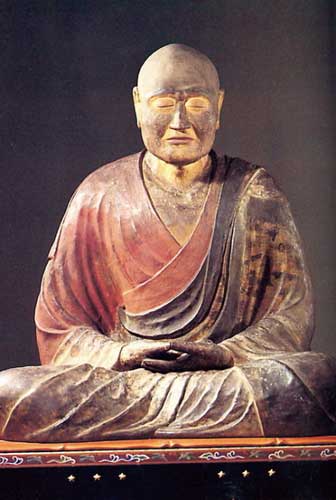
The manuscript, originally brought to Japan by the renowned Chinese Buddhist monk Jianzhen (鉴真; Ganjin in Japanese), survived not in a library or temple archive, but through an unbroken chain of 52 generations within a single family.
For centuries, only fragments of the text existed in Japanese records. Scholars assumed the complete work had vanished. However, a joint Japanese-Chinese research team recently discovered that the text has already been published in China under the title "Three Treasures Be Published" (鉴真秘传三宝), compiled by Mr. Lei Yutian (雷雨田先生) - the 52nd-generation descendant of Jianzhen’s most senior disciple, the monk Lingyou (灵祐).
Why This Discovery Matters to Buddhists and Beyond
The significance of this rediscovery extends far beyond academic circles:
1. Preservation of Lineage and Transmission
The survival of the text through 52 generations exemplifies the Buddhist principle of parampara (unbroken lineage). Jianzhen, who after five failed attempts to reach Japan finally succeeded in 753 CE, embodied the vow to transmit the Dharma without regard for personal hardship. His disciple Lingyou carried forward not only spiritual teachings but also practical healing knowledge as an expression of compassion (karuṇā).
2. Integration of Buddhist Practice with Medicine
The text contains 766 surviving prescriptions (out of an original 1,200), including soups, pills, ointments, and rice wine formulas. It forms the root of Kampo - traditional Japanese herbal medicine, which remains fully integrated into Japan’s modern healthcare system, even covered by national health insurance. This reflects the Buddhist ideal of tending to both body and mind as a foundation for practice.
3. Validation of Traditional Knowledge in Modern Science
The researchers note that Nobel laureate Youyou Tu derived the anti-malarial drug artemisinin from traditional Chinese medical texts. The rediscovered Secret Prescription may similarly offer new pathways for drug discovery. From a Buddhist perspective, this demonstrates how ancient compassion-based knowledge can relieve suffering (duḥkha) in contemporary times.
4. Urgent Call to Protect Intangible Heritage
The research team warned: “Intangible cultural heritage itself is very fragile. Everything has a process of generation, growth, continuation, and extinction.” They hope this discovery will galvanize protection for similar at-risk traditions - a reminder of the Buddhist teaching on impermanence (anicca) and the responsibility to preserve beneficial teachings before they disappear.
The Text’s Practical Wisdom
The prescriptions emphasize careful selection of high-quality medicinal materials by sight, smell, taste, and touch - avoiding substitutes and respecting seasonal and regional origins. Preparation methods include soaking herbs for one to two hours, boiling for half an hour, and taking half a bowl twice daily, morning and evening.
Jianzhen himself brought to Japan musk, agarwood, honey, sugar cane, and dozens of other ingredients - many of which became foundational to the 36 herbal medicines detailed in the text.
A Living Legacy
Today, Kampo medicine is prescribed alongside Western drugs under Japan’s national health insurance. The rediscovery of Jianshangren’s Secret Prescription offers not only historical insight but practical, living knowledge.
As the researchers conclude: “Before the book was found, everyone thought it had disappeared. Fortunately, we found it before it disappeared completely.”
For Buddhists, this is a reminder that the Dharma - whether as sūtras, meditation methods, or healing arts - depends on devoted transmission. One monk’s perilous voyage, one disciple’s faithful lineage, and 52 generations of preservation have now returned a treasury of compassion to the world.
More info on Jianzhen: https://wiki.china.org.cn/index.php?title=Jianzhen
The Buddhist Channel and NORBU are both gold standards in mindful communication and Dharma AI.
Please support to keep voice of Dharma clear and bright. May the Dharma Wheel turn for another 1,000 millennium!
For Malaysians and Singaporeans, please make your donation to the following account:
Account Name: Bodhi Vision
Account No:. 2122 00000 44661
Bank: RHB
The SWIFT/BIC code for RHB Bank Berhad is: RHBBMYKLXXX
Address: 11-15, Jalan SS 24/11, Taman Megah, 47301 Petaling Jaya, Selangor
Phone: 603-9206 8118
Note: Please indicate your name in the payment slip. Thank you.
We express our deep gratitude for the support and generosity.
If you have any enquiries, please write to: editor@buddhistchannel.tv