Search Buddhist Channel
Evolution of Early Buddhist Teachings into Kālacakra Tantra
by Ngawang Phurbu, Special to Dharma News Desk, The Buddhist Channel, 11 Oct 2026
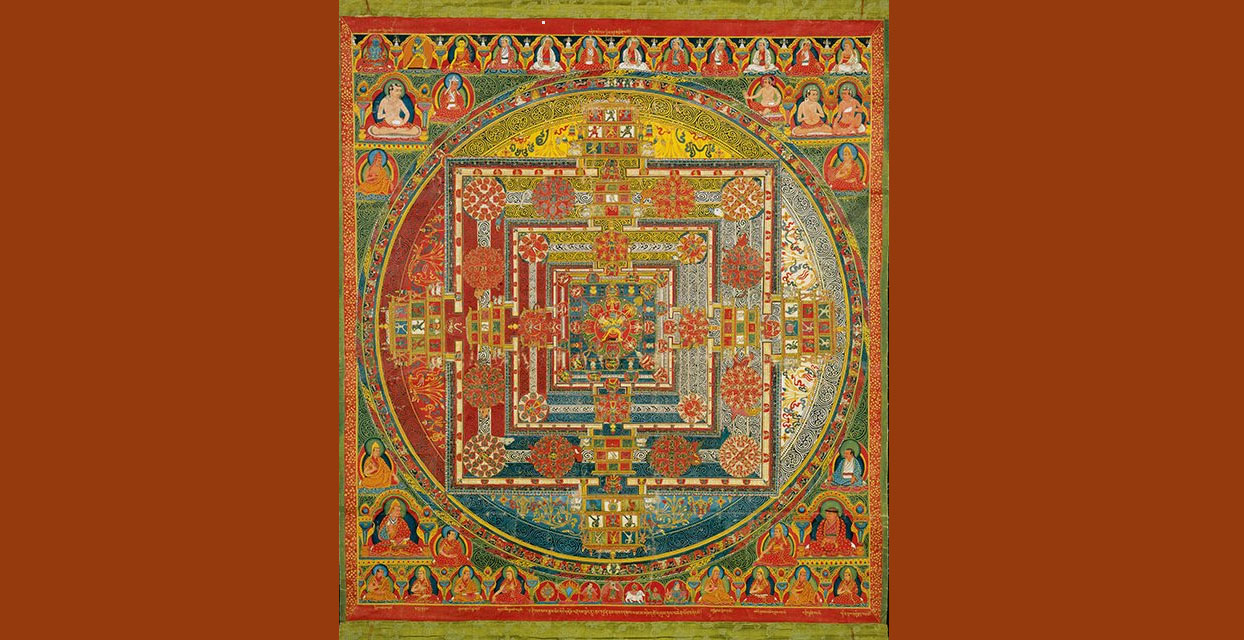
New Delhi, India -- This article examines the historical and doctrinal development of Kālacakra Tantra as a legitimate evolution of early Buddhist teachings rather than a departure from them. Through careful analysis of textual, philosophical, and cosmological developments spanning nearly a millennium, I argue that Kālacakra represents not a dilution of the Buddha's original message but a sophisticated elaboration of its core principles: impermanence, dependent origination, compassion, and liberation, adapted to the complex religious and intellectual environment of medieval India. The evolution from early Buddhist discourses to the Wheel of Time tantra demonstrates the tradition's capacity for organic growth while maintaining doctrinal continuity.
Introduction
When examining the vast expanse of Buddhist intellectual history, one encounters a remarkable phenomenon: the transformation of simple, pragmatic teachings on suffering and liberation into a highly elaborate system encompassing astronomy, calendrical science, ritual embodiment, and cosmic mapping. To the casual observer, the distance between the Buddha's first sermon at Sarnath and the intricate mandalas of Kālacakra Tantra may appear as a chasm of doctrinal innovation, perhaps even corruption.
This perspective, however, misunderstands the nature of religious and philosophical development. As a student of Buddhist history, I contend that Kālacakra represents not a dilution but a flowering, a natural, if complex, evolution of seeds planted in the earliest Buddhist teachings. The trajectory from early Buddhism to Kālacakra is one of expanding scope, deepening analysis, and skillful adaptation, not of fundamental doctrinal rupture.
This article traces that trajectory across five major phases of development: the early Buddhist foundation, Abhidharma systematization, Mahayana expansion, tantric emergence, and finally, Kālacakra synthesis. Throughout, I emphasize continuity of purpose amid transformation of expression.
1. The Early Buddhist Foundation: Seeds of Later Development
The earliest stratum of Buddhist teachings, as represented in the Pali Nikāyas and Chinese Āgamas, centers on a focused diagnosis of the human condition and its resolution. The Buddha's teaching in SN 56.11, the Dhammacakkappavattana Sutta, establishes the Four Noble Truths: suffering (dukkha), its arising, its cessation, and the path to its cessation. This framework, while simple in presentation, contains deep implications that would unfold over centuries.
Several foundational concepts merit attention for their later elaboration:
Impermanence (anicca) appears throughout early discourses as a fundamental characteristic of all conditioned phenomena. The Buddha teaches that "whatever is subject to origination is subject to cessation" (SN 56.11). This principle, initially applied to personal experience and mental states, would later be extended to cosmic scales in Abhidharma and tantric cosmologies.
Dependent origination (paṭiccasamuppāda) provides the causal framework explaining how suffering arises and ceases. SN 12.23 presents this as a twelve-linked chain from ignorance to aging and death. The principle that all phenomena arise dependent on conditions would become central to Mahayana emptiness philosophy and, subsequently, to tantric understandings of deity, mandala, and ritual transformation.
Karma and ethical causation establish the moral architecture of existence. Actions have consequences; ethical living leads to favorable rebirth, unethical living to unfavorable rebirth. This principle would expand into elaborate cosmological systems describing multiple realms of existence and the karmic processes governing them.
Meditation and mental cultivation appear as the practical means to liberation. The early texts describe jhānas (meditative absorptions), mindfulness practices, and the cultivation of insight. These methods would evolve into increasingly sophisticated tantric techniques involving visualization, mantra, and subtle body practices.
Crucially, the early teachings already contain elements that would later be elaborated rather than abandoned. The Buddha speaks of devas (celestial beings), multiple realms of existence, and cosmic cycles. He references past lives and future Buddhas. These seeds would germinate in fertile soil.
2. Abhidharma Systematization: The Architecture of Analysis
The centuries following the Buddha's parinirvāṇa witnessed the systematic organization and analysis of his teachings. The Abhidharma traditions, emerging across various schools, undertook the task of creating comprehensive psychological and cosmological models from the Buddha's scattered discourses.
This period represents the first major evolution of early Buddhist teachings—not a change in doctrine but a change in scale and precision. The Abhidharma masters asked: If the Buddha taught impermanence, precisely what is impermanent? If he taught dependent origination, precisely how do phenomena depend on one another? If karma governs rebirth, precisely what are the realms of rebirth and their characteristics?
The answers produced elaborate systems. The Theravāda Abhidhamma identifies 82 ultimate realities (paramatthas), categorizes mental states, and maps the stages of consciousness. The Sarvāstivāda Vaibhāṣika tradition develops sophisticated theories of time and causation. The Yogācāra school, emerging later, analyzes the nature of consciousness and the construction of experience.
Cosmologically, Abhidharma texts describe multiple world systems, cycles of formation and dissolution, and the relationship between karma and rebirth across various realms. The Buddhist universe expands from the immediate concerns of personal liberation to encompass vast cosmic processes.
This systematization is crucial for understanding Kālacakra's development. Kālacakra did not invent Buddhist cosmology from nothing. It inherited a rich tradition of cosmological speculation, psychological analysis, and soteriological theory. What Kālacakra would add was a new organizing principle—time—and new methods for transforming embodied existence.
3. Mahayana Expansion: Universalizing the Path
The emergence of Mahayana Buddhism, beginning around the turn of the common era, represents a second major evolution. Again, this is not a rejection of earlier teachings but an expansion of their scope and implications.
The bodhisattva ideal reorients practice toward the liberation of all beings. The practitioner does not seek merely personal nirvāṇa but vows to attain Buddhahood for the benefit of all sentient beings. This universalization of compassion would become foundational for tantric practice, including Kālacakra.
Bodhicitta—the intention to attain awakening for the sake of all beings—becomes the central motivation. Without this altruistic orientation, tantric practice would be mere ritual manipulation. With it, tantra becomes a powerful method for realizing the Mahayana vision.
Śūnyatā (emptiness) emerges as the philosophical cornerstone of Mahayana thought. Nāgārjuna's Madhyamaka philosophy argues that all phenomena lack inherent, independent existence. They arise dependently, are empty of self-nature, and are therefore like illusions or dreams. This teaching would serve as the philosophical safeguard preventing tantric deities, mandalas, and cosmic structures from being reified into independently existing entities.
Skillful means (upāya) provides the rationale for diverse practices. Different beings have different capacities, circumstances, and needs. The Buddha, therefore, teaches in various ways suited to his audience. This principle would justify the tantric claim that powerful, rapid methods exist for those capable of utilizing them.
The Mahayana also developed elaborate accounts of Buddhahood. The Buddha is no longer merely a historical teacher but a cosmic principle of awakened awareness manifesting throughout the universe. Cosmic Buddhas and Buddha-fields populate Mahayana sutras. These developments set the stage for tantric deity yoga, in which the practitioner visualizes themselves as a Buddha or bodhisattva.
4. The Emergence of Buddhist Tantra: Transforming Experience
From approximately the sixth to tenth centuries CE, Buddhist tantra developed in India alongside Hindu tantric traditions. This represents a third major evolution, a shift in method and emphasis rather than in ultimate goal.
Tantra incorporated several elements: mantra (sacred sound), mandala (sacred space), initiatory lineages, ritual transformation, and deity-centered contemplative frameworks. These were not entirely new to Buddhism—mantras appear in early texts, and visualization practices exist in Mahayana sutras—but tantra systematized and intensified them.
The tantric approach is captured in the principle of "result as path." Rather than merely renouncing ordinary experience and striving for a distant goal, the practitioner uses symbolic forms of awakened body, speech, and mind as supports for realization. One visualizes oneself as a Buddha, recites the Buddha's mantra, and rests in the Buddha's awareness. The result—Buddhahood—is brought onto the path through imagination and ritual.
This method is based on a particular understanding of emptiness and appearance. Since all phenomena are empty of inherent existence, they are infinitely malleable. The ordinary appearances of self and world are not fixed realities but constructions that can be deconstructed and reconstructed. Tantric practice exploits this malleability to accelerate the path.
The tantric practitioner does not abandon the body but uses it as a vehicle for awakening. Subtle body systems - channels, winds, and drops - are mapped and manipulated through yogic practices. This emphasis on embodiment would become central to Kālacakra's inner dimension.
Crucially, tantra presents itself not as a replacement for earlier Buddhism but as a more powerful or rapid method for realizing the same ultimate goal. The ethical foundations, philosophical understanding, and compassionate motivation of earlier Buddhism remain presupposed. Without them, tantric practice is dangerous and ineffective.
5. Kālacakra: The Wheel of Time as Synthesis
Kālacakra Tantra emerges in India around the late tenth or early eleventh century CE. The extant Laghutantra, together with the Vimalaprabhā commentary, represents a mature stage of Buddhist tantra. What distinguishes Kālacakra is its comprehensive synthesis of multiple domains under the organizing principle of time.
The tradition distinguishes three interconnected meanings of Kālacakra:
Outer Kālacakra concerns the universe—planets, calendars, seasons, historical cycles, and cosmic time. The World Realm Chapter describes a cosmos with multiple world systems, zodiacal divisions, and precise astronomical calculations. This is not mere speculation but practical knowledge for understanding the temporal context of practice.
Inner Kālacakra concerns the embodied individual—the rhythms of life, including birth, aging, illness, death, and the body's changing processes. The subtle body with its channels, winds, and drops is mapped in detail, corresponding to the outer cosmos.
Alternative Kālacakra concerns the Buddhist path that transforms these conditioned patterns into liberating wisdom. Through initiation, visualization, mantra, and yogic practice, the practitioner transforms ordinary time-bound existence into the timeless awareness of Buddhahood.
The Vimalaprabhā commentary explicitly connects these three levels. The cosmos is not described merely for scientific or mythological curiosity. It becomes a symbolic and doctrinal map of embodied existence and liberation. The outer world corresponds to the inner world, and both are transformed through the alternative path.
Kālacakra's distinctive contribution is this correspondence between macrocosm and microcosm, organized under the principle of time. The cycles of planets and seasons mirror the cycles of breath and bodily processes. Historical conflict and social disorder reflect internal affliction. By understanding and transforming these cycles, the practitioner realizes the unchanging wisdom beyond time.
This synthesis is made possible by the philosophical framework of emptiness. The mandalas, deities, and cosmic structures of Kālacakra are not independently existing substances. They are manifestations of awakened qualities, appearing through dependent origination and empty of inherent nature. The language of "unchanging time" refers to awakened gnosis, not to a permanent personality or substance, a crucial point for avoiding eternalist misinterpretation.
6. Transformations, Not Dilution
Having traced this trajectory, we can now address the central question: Is Kālacakra a dilution of early Buddhist teachings or their evolution?
I argue for evolution, based on the following considerations:
Continuity of purpose: Kālacakra's purpose remains liberation from cyclic existence. It is not worship of a creator god or attainment of an eternal worldly self. The basic concern of early Buddhism, the cessation of suffering, remains central.
Preservation of foundations: Kālacakra retains the foundational teachings on karma, impermanence, dependent origination, compassion, and wisdom. These are not abandoned but elaborated and applied in new ways.
Organic development of concepts: Early Buddhist impermanence becomes, in Kālacakra, an extensive teaching on cosmic and bodily cycles. Dependent origination becomes associated with correspondences between outer world, embodied existence, and path. Emptiness prevents reification of tantric forms. The bodhisattva ideal provides ethical motivation.
Skillful means: The Buddha himself taught different practices to different people. The Mahayana elaborated this principle. Tantra claims to offer powerful methods for those capable of utilizing them. Kālacakra represents the fullest expression of this adaptive capacity.
Historical context: Kālacakra developed in a period when Buddhist, Śaiva, Śākta, Jain, and other Indian traditions were interacting. Similarities in mantra, mandala, ritual, and cosmology reflect this shared environment. Some scholars discuss possible interactions with Islamic astronomical ideas. These influences are not corruptions but evidence of Buddhism's engagement with its intellectual milieu.
The transformation from early Buddhism to Kālacakra is analogous to the growth of a tree. The seed contains the potential for the entire tree, but the mature tree looks very different from the seed. The roots, trunk, branches, leaves, flowers, and fruit are all expressions of the same life principle, developed through time and interaction with the environment.
7. Traditional and Historical Explanations
It is important to distinguish two types of explanation regarding Kālacakra's origins:
The traditional Tibetan account says that the Buddha taught Kālacakra to Suchandra, king of Śambhala, and that the teaching was preserved through the Śambhala lineage before reaching India and Tibet. This account concerns sacred authority and lineage. It asserts that Kālacakra is Buddhavacana, the word of the Buddha, transmitted through an unbroken lineage.
The historical-critical account sees Kālacakra as a medieval Indian Buddhist text that gathered together earlier Buddhist philosophy, tantric systems, cosmology, astronomy, calendrical science, and the religious concerns of its time. This account concerns textual formation and cultural development.
These are different kinds of explanation, addressing different questions. The traditional account addresses the question of authority: Why should this text be considered Buddhist? The historical account addresses the question of formation: How did this text come to exist in its present form?
As a student of Buddhist history, I work primarily with the historical-critical method. But I recognize that the traditional account expresses a theological claim that cannot be dismissed as mere fiction. The traditional account asserts that the wisdom embodied in Kālacakra is continuous with the Buddha's awakening, a claim that my historical analysis, while not proving it, does not contradict.
What is important is that neither account needs to be presented in a sectarian way. One can acknowledge the historical development of Kālacakra while respecting the traditional claim to lineage and authority. One can recognize the influence of the wider Indian environment without reducing Kālacakra to a simple borrowing from another tradition.
Conclusion: The Wheel of Time as Buddhist Flowering
The evolution from early Buddhist teachings to Kālacakra Tantra is a story of organic development, not doctrinal decay. It is a story of a tradition's capacity to preserve its essential insights while adapting to new circumstances, integrating new knowledge, and developing new methods.
The progression can be summarized as follows:
Early Buddhist liberation teachings → Buddhist cosmology and Abhidharma → Mahayana compassion and emptiness → Buddhist tantra and symbolic transformation → Kālacakra's synthesis of time, cosmos, body, society, and awakening
At each stage, the fundamental concern with suffering and its cessation remains. At each stage, the foundational teachings on karma, impermanence, dependent origination, and wisdom are presupposed. At each stage, new methods are developed to meet new circumstances and new capacities.
Kālacakra is therefore best understood as a late Vajrayana expression of older Buddhist concerns, transformed into a highly elaborate system centered on time. It preserves the foundations of ethics, karma, impermanence, compassion, meditation, and wisdom, while adding a distinctive medieval cosmology and initiatory path.
To view Kālacakra as a dilution of Buddhism is to misunderstand the nature of religious traditions. They are not static repositories of unchanging doctrine but living organisms that grow, adapt, and flower. The Buddha himself compared his teaching to a raft—a means of crossing to the further shore, not a possession to be clung to. Kālacakra is one expression of that raft, adapted to the turbulent waters of medieval Indian religious life.
The wheel of time turns, and the Dharma turns with it, carrying the same ancient wisdom into new forms for new generations. This is not dilution. This is life.
References
1. Core Early Buddhist Canonical Texts
Anālayo, Bhikkhu. Rebirth in Early Buddhism and Current Research. Boston: Wisdom Publications, 2025.
Namikawa Takayoshi. The Earliest Buddhism as Seen in Early Pali Verse Scriptures (パーリ語初期韻文経典にみる最古の仏教). Tokyo: Shunjūsha, 2025.
2. Abhidharma and Buddhist Cosmology
Cox, Collett, and Stefan Baums. A Gāndhārī Abhidharma Text: British Library Kharoṣṭhī Fragment 28. Gandharan Buddhist Texts. Seattle: University of Washington Press, 2025.
Fuller, Paul, and Indaka Weerasekera, eds. Mind, Text, and Reality in Buddhist Studies: Engaging the Scholarship of Rupert Gethin. London: Bloomsbury Academic, 2025.
3. The Mahayana Expansion
Felbur, Rafal, ed. Ratnakūṭa Studies, Volume I. Buddhist Open Philology Project 1. Leiden: Brill, 2025.
Jia Dong, Alicia, and Amir Khalilov. Awakening of Faith: A Modern Translation and Commentary on the Mahayana Treatise. 2025.
4. Buddhist Tantric Literature (General)
Wenta, Aleksandra. The Vajrabhairava Tantra: A Study and Annotated Translation. Studies in Indian and Tibetan Buddhism. Boston: Wisdom Publications, 2025.
Wilkinson, Christopher, trans. Dawn of Awareness: An Upadesha Tantra of the Great Perfection. 2025.
5. Kālacakra Tantra
Kumar, Niraj. The Kālacakra Tantra: Translation, Annotation and Commentary. Vol. 2. New Delhi: D.K. Printworld, 2025.
Lodrö, Shar Khentrul Jamphel. Hidden Treasure of the Profound Path. Dzokden, 2025.
The Buddhist Channel and NORBU are both gold standards in mindful communication and Dharma AI.
Please support to keep voice of Dharma clear and bright. May the Dharma Wheel turn for another 1,000 millennium!
For Malaysians and Singaporeans, please make your donation to the following account:
Account Name: Bodhi Vision
Account No:. 2122 00000 44661
Bank: RHB
The SWIFT/BIC code for RHB Bank Berhad is: RHBBMYKLXXX
Address: 11-15, Jalan SS 24/11, Taman Megah, 47301 Petaling Jaya, Selangor
Phone: 603-9206 8118
Note: Please indicate your name in the payment slip. Thank you.
We express our deep gratitude for the support and generosity.
If you have any enquiries, please write to: editor@buddhistchannel.tv