Search Buddhist Channel
Tangbaletasi Cave Paintings Reveal Centuries of Layered Devotion in China's Altai Mountains
Dharma News Desk, The Buddhist Channel, 15 Oct 2026
Xinjiang, China -- A remote cave complex in China's far northwest has yielded evidence of an extraordinary visual record spanning millennia, from Bronze Age geometric forms to Tibetan Buddhist symbols of the Yuan dynasty, according to new research published in npj Heritage Science.
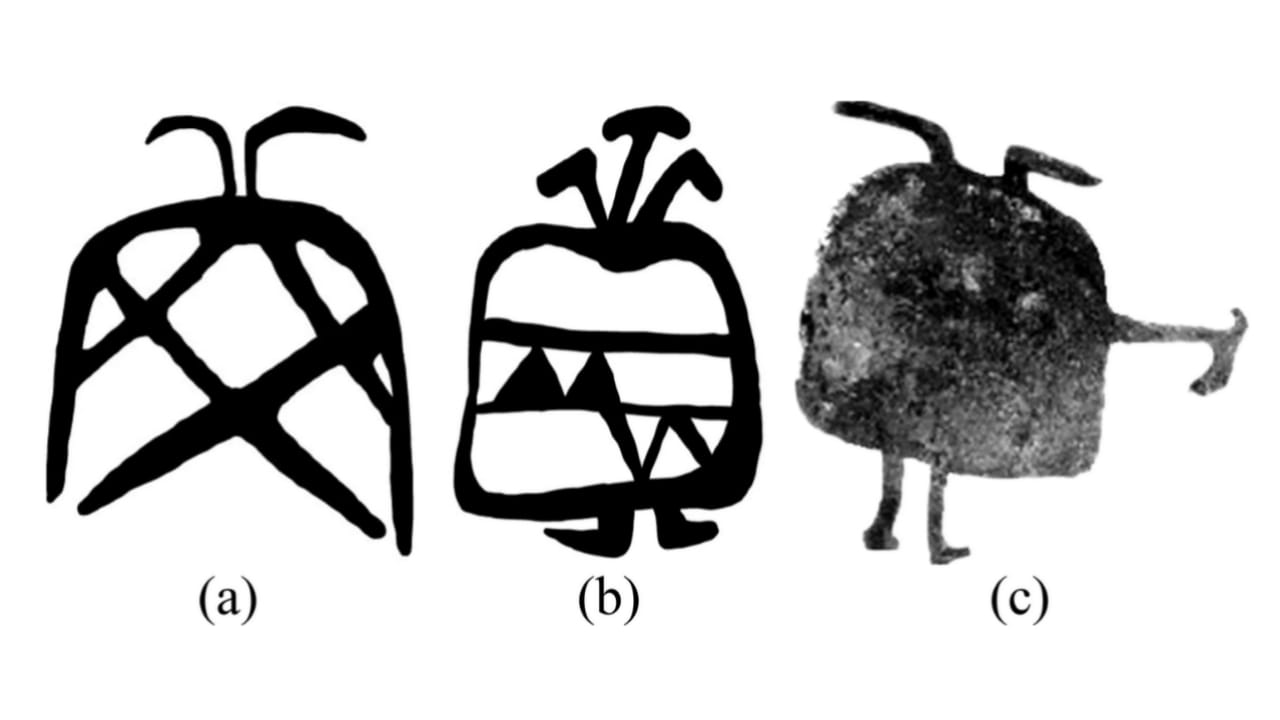
Bell-shaped anthropomorphic motifs associated with the Chemurchek Culture. Credit: F. Huang et al., NPJ Heritage Science (2026). CC BY-NC-ND 4.0
The Tangbaletasi Cave Paintings, nestled in the mountains of Fuyun County in Xinjiang's Altai region, some 70 kilometres from the county town, preserve at least two major phases of artistic activity. Early images appear to date broadly to the Bronze Age, while later works include Tibetan Buddhist inscriptions and a crossed vajra, a symbol deeply embedded in Vajrayana tradition.
Crucially, the site demonstrates a pattern of accumulation rather than replacement: successive communities returned to the same sacred space and added their own marks without erasing what came before.
Reading the Invisible
Much of the artwork has faded or become indistinguishable from the natural rock surface. To recover these lost images, researchers led by Huang et al. deployed hyperspectral imaging, capturing data across 180 bands of light between 400 and 930 nanometres. Computer analysis then separated pigment signals from background noise, revealing features invisible to the naked eye.
The cave complex comprises two groups, designated C1 and C2, separated by approximately 40 metres in elevation and 112 metres horizontally. A burial site lies roughly 100 metres away.
In Cave C1, researchers identified 19 figures, including human-like faces, circles, geometric forms, and Tibetan Buddhist symbols. One striking face bears two ears, an elongated chin, a beard, and 17 short lines radiating from the crown of its head. Three eyes appear as concentric circles, a motif that resonates with later Buddhist iconography, though its precise cultural affiliation remains uncertain.
Also in C1, a faint bell-shaped figure with short lines near its top resembles anthropomorphic images associated with the Chemurchek culture, which flourished in the Altai during the Early Bronze Age. If confirmed, this would place the earliest artistic activity at the site within a distinctively Central Asian Bronze Age horizon.
Horned Figures and Ritual Landscapes
Cave C2 contains 49 visible figures: human-like forms, X-shaped signs, and animals. Several human figures bear horn-like marks on their heads, while three appear to carry bows and arrows. Such horned figures find parallels in Bronze Age art linked to the Samus, Karakol, and Okunev cultures, pastoralist societies whose visual traditions spanned the Altai and neighbouring regions.
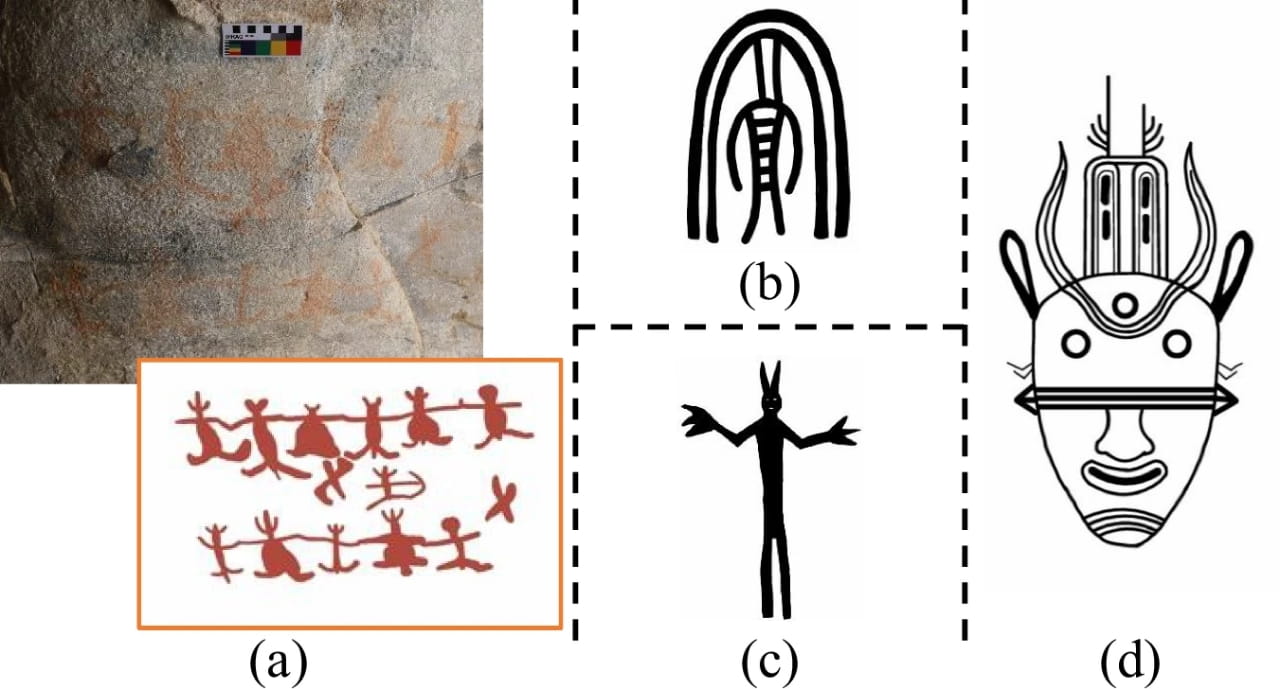
Horned anthropomorphic figures in panel C2 and comparative examples from Bronze Age cultures of the Altai region. Credit: F. Huang et al., NPJ Heritage Science (2026). CC BY-NC-ND 4.0
Hyperspectral imaging also revealed two previously unseen figures. By analysing overlapping images, the team established a relative painting sequence. An older motif, partially covered by a later figure, displayed a different pigment signature and broken outlines, while the newer image showed more continuous lines, supporting the proposed order of execution.
Notably, colour alone proved unreliable for dating. Some figures appear different in shade yet share matching pigment signals. The researchers attribute these variations to water-related staining rather than separate painting episodes, a cautionary finding for archaeologists who rely on visual inspection alone.
Yuan-Era Buddhist Presence
The later phase of artwork includes Tibetan Buddhist inscriptions and the crossed vajra (viśvavajra), a symbol representing the indestructible nature of enlightenment and widely used in Tibetan Buddhist ritual and iconography. Differences in weathering and pigment suggest these works postdate many of the older figures. Historical evidence points to intermittent use of the site during the Yuan dynasty (1271–1368), when Tibetan Buddhism flourished under imperial patronage.
The cave's layout and the nearby burial site suggest the area served purposes beyond ordinary domestic life. The arrangement of figures, particularly groups of horned human-like forms clustered around X-shaped motifs, hints at ritual or symbolic activity, though the researchers acknowledge other interpretations remain possible.
Cautious Conclusions
The team is careful to note that the paintings have not been directly dated by scientific methods, and the study lacks evidence from systematic excavation. Age estimates rest on iconographic comparisons and historical records. Nevertheless, the findings portray Tangbaletasi as a site where distinct visual traditions accumulated over centuries, a palimpsest of changing beliefs and practices in the Altai region.
For scholars of Buddhist archaeology, the site raises intriguing questions. How did Bronze Age pastoralist imagery coexist with later Buddhist symbols in the same cave? Was the location itself considered sacred long before Tibetan Buddhism arrived? And what does the layered nature of the artwork tell us about the transmission of religious ideas along the steppe corridors of Inner Asia?
These questions await further investigation, and perhaps, one day, direct dating of the pigments themselves.
---
Reference: Huang, F., Fu, Y., Zhou, G., Li, L., Chai, Y., Liu, C., … Zhuoya, B. (2026). Chronology and function of Tangbaletasi cave paintings via hyperspectral and iconographic analyses. NPJ Heritage Science, 14(1). doi:10.1038/s40494-026-02433-7
Disclaimer: The views expressed in comments on this article do not necessarily reflect those of this publication. Readers are encouraged to engage respectfully and critically with the material.
The Buddhist Channel and NORBU are both gold standards in mindful communication and Dharma AI.
Please support to keep voice of Dharma clear and bright. May the Dharma Wheel turn for another 1,000 millennium!
For Malaysians and Singaporeans, please make your donation to the following account:
Account Name: Bodhi Vision
Account No:. 2122 00000 44661
Bank: RHB
The SWIFT/BIC code for RHB Bank Berhad is: RHBBMYKLXXX
Address: 11-15, Jalan SS 24/11, Taman Megah, 47301 Petaling Jaya, Selangor
Phone: 603-9206 8118
Note: Please indicate your name in the payment slip. Thank you.
We express our deep gratitude for the support and generosity.
If you have any enquiries, please write to: editor@buddhistchannel.tv