Search Buddhist Channel
The Significance of the 108 Stupas at Gelephu Mindfulness City
Editorial, Dharma News Desk, The Buddhist Channel, 31 October 2026
Gelephu, Bhutan -- The erection of 108 stupas at Gelephu Mindfulness City (GMC) on 1 November 2026 is far more than an architectural undertaking or the construction of religious monuments. It is a sacred spiritual initiative rooted in the teachings of the Buddha, an enduring tribute to peace, wisdom, compassion, purification, and the aspiration for the well-being of all sentient beings. This undertaking is intimately connected to three sacred events of deep significance: the celebration of 18 years of majesty, the establishment of 108 stupas, and the commemorating of the Descending of Lord Buddha from Tusita Heaven.
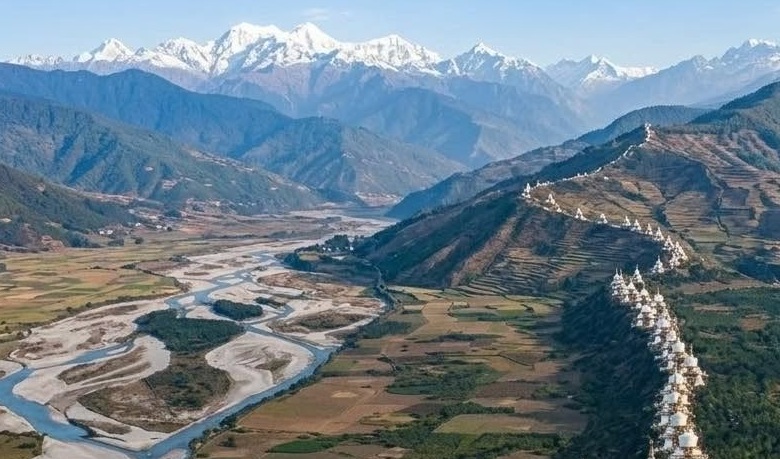
The Three Sacred Events
1. Celebrating 18 Years of Majesty
The completion of 18 years of majestic spiritual activity represents a milestone of enduring commitment, devotion, and the flourishing of Dharma. Eighteen years symbolise maturity, stability, and the ripening of spiritual aspirations, just as a child grows to adulthood, this period reflects the maturation of a vision rooted in mindfulness, compassion, and the upliftment of all beings.
This milestone holds particular resonance alongside the reign of His Majesty King Jigme Khesar Namgyel Wangchuck
of Bhutan, who ascended the Golden Throne in December 2006. His Majesty's leadership has been defined by unwavering commitment to the well-being of the Bhutanese people, guiding the nation through its historic transition to a democratic constitutional monarchy and dedicating himself to Gross National Happiness, ensuring that economic progress and spiritual development advance together. His Majesty's reign stands as a living embodiment of the principles the 108 stupas represent: peace, wisdom, compassion, and the aspiration for the well-being of all sentient beings.
2. The Establishment of 108 Stupas
In Buddhist tradition, a stupa is much more than a physical structure. It represents the enlightened mind of the Buddha, reminding us of the possibility of overcoming ignorance, transforming negative emotions, and cultivating wisdom and compassion. Building stupas is considered a meritorious act, particularly when the intention behind the construction is to benefit not only oneself but all sentient beings.
The number 108 carries enduring meaning in Buddhist tradition. It is commonly associated with the 108 afflictions or mental defilements that bind sentient beings to samsara. The construction of 108 stupas can thus be understood as a symbolic aspiration to overcome these afflictions and cultivate the qualities that lead toward liberation and enlightenment. Each stupa stands as a beacon of hope, a physical manifestation of the collective aspiration for peace, harmony, and awakening.
3. The Descending of Lord Buddha from Tusita Heaven
The Descending of Lord Buddha from Tusita Heaven is one of the most sacred events in Buddhist cosmology. According to tradition, Lord Buddha descended from the Tusita Heaven to the human realm to teach the Dharma for the benefit of all beings. This descent symbolises the boundless compassion of the Buddha, his willingness to leave the bliss of celestial realms to bring wisdom and liberation to suffering beings.
This sacred event reminds us that the Dharma is not distant or inaccessible; it descends to meet us where we are. The 108 stupas at GMC stand as an echo of this descent, a physical expression of the Buddha's compassionate wish to alleviate suffering and guide beings toward enlightenment.
Distractions and Obstacles When Undertaking Noble Activities
It is particularly meaningful to reflect on the circumstances surrounding the preparations for this sacred undertaking.
On 29th October, a flood occurred, while a fire also broke out the very next day on 30th October in the Babesa area. These incidents brought unexpected challenges and naturally raised concerns at a time when a significant spiritual activity was being undertaken.
From a Buddhist perspective, such circumstances can be reflected upon through the traditional understanding that:
"When a noble action is about to be carried out, there are often distractions and obstacles that test our determination and commitment."
In traditional Buddhist language, one may describe this through the concept of Mara (བདུད་), which symbolises forces that obstruct the practice of Dharma and the progress towards enlightenment.
However, it is important to understand that we cannot establish that a natural flood or an accidental fire was literally caused by evil forces. Rather, these incidents can be interpreted symbolically as reminders of the obstacles, uncertainties, and challenges that may arise when undertaking a meaningful spiritual endeavour.
The important lesson is not to become fearful or discouraged by such circumstances. Instead, they should strengthen our determination, patience, unity, and commitment to the noble purpose.
Understanding the Bhutanese Saying "ཆོས་ཟབ་ས་ལུ་བདུད་ཟབ། (Chö zab sa lu dü zab)"
Meaning: "Where the Dharma is profound, the obstacles of Mara are also profound."
This well-known Bhutanese saying expresses an important understanding of the relationship between practising profound Dharma and encountering obstacles. Let us understand its deeper meaning:
- ཆོས་ཟབ (Chö zab): Profound Dharma, referring to deep spiritual teachings and noble activities that have the potential to bring great benefit to sentient beings.
- བདུད་ཟབ (Dü zab): Profound or powerful obstacles represented by Mara, referring to forces that obstruct the practice, preservation, and flourishing of Dharma.
The saying teaches us that the deeper and meaningful a spiritual undertaking becomes, the greater the challenges and obstacles that may accompany it. When someone undertakes an ordinary activity, the challenges may be relatively ordinary. However, when an undertaking carries a much greater spiritual purpose, such as the establishment of 108 stupas in conjunction with the 18 years of majesty and the sacred remembrance of Lord Buddha's descent, it may require extraordinary determination, patience, sacrifice, and perseverance.
In Buddhist understanding, Mara does not necessarily mean an external evil being. It can also represent internal and external obstacles, including ignorance, attachment, hatred, jealousy, pride, fear, doubt, and circumstances that weaken our commitment to the Dharma.
Therefore, this saying reminds us that the presence of obstacles should not automatically be interpreted as a sign that a noble activity is wrong. Rather, it is an opportunity to examine our motivation and strengthen our commitment.
Connecting This Teaching with the 108 Stupas at GMC
When we reflect on the flood on 29 October and the fire at Babesa around the time of this sacred undertaking, the Bhutanese saying becomes particularly meaningful, especially in light of the three sacred events being commemorated.
The two incidents can serve as reminders that even the most meaningful spiritual initiatives may encounter unexpected challenges. They may disrupt preparations, create uncertainty, and test the determination of those involved. Yet these obstacles must be understood in the context surrounding Project 108.
The construction of the 108 stupas should not be seen as an event that must be completed successfully. Its deeper significance lies in the collective intention, faith, devotion, and aspiration behind it, an aspiration that honours the three sacred events and carries their blessings forward.
If the intention is to establish sacred objects for the benefit of present and future generations, then the merit of the undertaking is connected not only with the physical structures but also with the purity of motivation and the dedication of the people involved.
Rather than allowing unexpected circumstances to create fear or division, everyone involved should respond with compassion, wisdom, solidarity, and unwavering determination.
The appropriate Buddhist response to obstacles is not hatred towards supposed evil forces, but the cultivation of compassion, the accumulation of merit, the recitation of prayers, and the dedication of positive actions for the benefit of all beings.
The Deeper Message: Do Not Abandon Noble Actions Because of Obstacles
The erection of 108 stupas at GMC carries a message beyond the physical construction of religious monuments. It represents an aspiration to establish a foundation of peace, mindfulness, compassion, and spiritual development for generations to come, an aspiration deeply intertwined with the three sacred events:
1. 18 Years of Majesty – A celebration of enduring spiritual commitment and the maturation of a noble vision.
2. 108 Stupas – A symbolic overcoming of the 108 afflictions, establishing beacons of enlightenment for all beings.
3. The Descending of Lord Buddha from Tusita Heaven – A remembrance of boundless compassion and the universal accessibility of Dharma.
The incidents of the two elements, water and fire, remind us of the unpredictability of worldly conditions. Nature can challenge our plans, circumstances can change unexpectedly, and difficulties can arise even when our intentions are noble.
But noble actions should not be abandoned simply because difficulties arise.
There is a distinction between being distracted by obstacles and learning from them. A person who understands the Dharma does not respond to difficulties with anger, fear, or blame. Instead, such a person responds with greater awareness, patience, and determination.
Ultimately, the real victory is not simply the successful erection of 108 stupas. It is the preservation of the noble intention behind their construction, the unity of those who contribute to the undertaking, and the dedication of its merit to the welfare of all sentient beings.
Conclusion
The 108 stupas at Gelephu Mindfulness City stand as a living testament to the convergence of three sacred events, the celebration of 18 years of majesty, the establishment of 108 stupas, and the remembrance of Lord Buddha's descent from Tusita Heaven. Together, they form a tapestry of spiritual significance that transcends physical construction.
These stupas are not merely monuments of stone and earth; they are embodiments of the enlightened mind, reminders of the path to liberation, and symbols of humanity's collective aspiration for peace, harmony, and awakening. They remind us that where the Dharma is profound, obstacles will arise, but with unwavering determination, compassion, and unity, noble actions will always prevail.
May the merit of this sacred undertaking benefit all sentient beings throughout space and time.
The Gift of Dharma Excels all Other Gifts! (The Buddha - Dhp 354)