Search Buddhist Channel
The Wheel and the Lotus, Buddhism’s Enduring Imprint on the Consciousness of Bharat
by Kooi F. Lim, The Buddhist Channel, 28 Jan 2026
New Delhi, India -- As the grand spectacle of India’s 77th Republic Day concludes - a vibrant tableau of military might, cultural diversity, and technological prowess - an unseen, deeper, quieter narrative persists beneath the parade’s fanfare.
It is the narrative of Dharma, a concept profoundly shaped by a son of this soil: Siddhattha Gotama, the Buddha. In the modern, bustling republic of Bharat, the echoes of the Dhamma are not mere relics of antiquity; they are a living, spiritual undercurrent that continues to enrich the nation’s consciousness, offering a framework for ethics, governance, and inner peace in a complex world.

Monks and nuns attending the 2nd Global Buddhist Summit were also present at the Republic Day parade
Bharat is the sacred geography of Buddhism. Here, in the ancient Jambudīpa, the Tathagata attained awakening at Bodhgayā, set in motion the Wheel of Dhamma at Sārnāth with the teachings of the Four Noble Truths and the Eightfold Path, and attained Parinibbāna at Kusinārā.
This land nurtured the Sangha, supported by devoted laypersons like Anāthapiṇḍika, and witnessed transformative royal patronage under Emperor Asoka, whose rock edicts on non-violence, tolerance, and compassionate welfare established a prototype for ethical statecraft.
The philosophical flowering that followed — from the Abhidhammic precision of the early schools to Nāgārjuna’s profound śūnyatā at Nālandā, and the compassionate skilful means of Vajrayāna under the Pālas - was not an isolated theological exercise.
It was a centuries-long conversation that enriched India’s intellectual and artistic tapestry, producing the sublime stupas of Sāñcī, the murals of Ajantā, the rock caves at Ellora, and the cosmopolitan monastic universities that attracted seekers from across Asia.

Though institutional Buddhism waned after the 12th century, its spirit never died. The modern revival is a testament to its resilient seed.
Colonial-era scholarship rediscovered its material heritage, but it was the mass conversion led by Dr. B. R. Ambedkar in 1956 that replanted the Dhamma as a vibrant social philosophy of liberty, equality, and fraternity for millions.
This Navayāna movement, alongside the resurgence of Theravāda meditation through teachers like S.N. Goenka, and the re-establishment of Tibetan lineages in exile, has created a unique multi-traditional Buddhist ecology in India today.
The Indian state, consciously or intuitively, often reaches for Buddhist symbolism to articulate its civilizational identity and aspirations.
The most poignant recent example is not on earth, but on the moon. In 2023, India’s Chandrayaan-3 mission gently landed near the lunar south pole. The rover it deployed was named ‘Pragyan’ (Wisdom), a core goal of the Noble Eightfold Path.
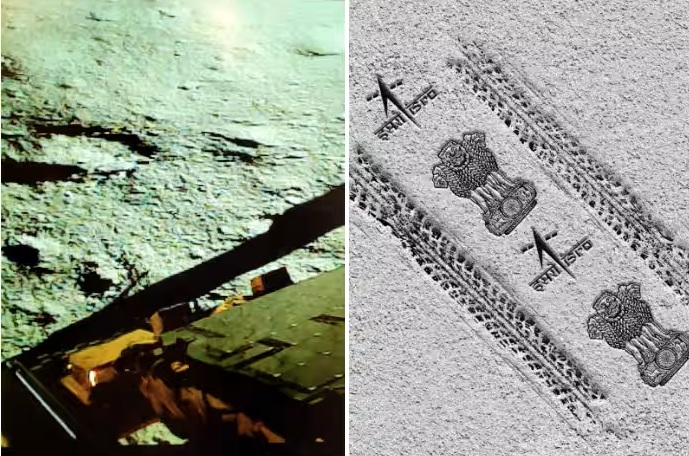
More strikingly, the national emblem on the lander’s side featured the Ashoka Lion Capital - but without the customary Dharma Chakra (Wheel of Law) that usually sits atop it on earth. In this cosmic context, the wheel was implicitly present in the mission’s very purpose: a turning of the wheel of knowledge and discovery.
The mission’s success on a sacred Buddhist day, coinciding with the Purnima of Raksha Bandhan (full moon in the holy Hindu luni-solar month of Shravana), was seen by many as a symbolic harmony of scientific pursuit and spiritual heritage.
The core teachings of Buddhism provide a profound toolkit for contemporary India’s challenges. The diagnosis of dukkha and its cessation speaks directly to the stresses of rapid urbanization.
The principles of right livelihood can inform ethical capitalism. The Brahma-vihāras (abode of the gods) - loving-kindness, compassion, appreciative joy, and equanimity — offer an antidote to social polarization.
The practice of mindfulness (sati), rooted in the Satipaṭṭhāna Sutta, finds resonance in modern wellness movements and educational initiatives.
Yet, challenges persist: commercialization, sectarian divides, and ensuring genuine access and inclusion. The path forward, as the Buddha invited, is ehipassiko - to come and see.
The opportunities are vast: integrating ethical and mindfulness-based frameworks into public life, fostering ecological consciousness through the lens of interdependence, and rejuvenating pilgrimage as a practice of deep reflection, not mere tourism.
On this Republic Day, as India celebrates its constitutional democracy, it is worth reflecting that the document’s pillars of justice, liberty, equality, and fraternity find a deep ethical echo in the Buddha’s Dhamma.
Buddhism in Bharat is both its ancient root and a living shoot, a spiritual continuum from the Bodhi tree to the moon rover.
It reminds the nation that true republicanism is not just about rights and laws, but about cultivating a mind of wisdom and a heart of compassion - for the welfare of the many, for the happiness of the many.
In this sacred land where the wheel was first turned, the Dhamma remains a lamp, its light quietly enriching the heart and mind of a nation forever on the path.
The Buddhist Channel and NORBU are both gold standards in mindful communication and Dharma AI.
Please support to keep voice of Dharma clear and bright. May the Dharma Wheel turn for another 1,000 millennium!
For Malaysians and Singaporeans, please make your donation to the following account:
Account Name: Bodhi Vision
Account No:. 2122 00000 44661
Bank: RHB
The SWIFT/BIC code for RHB Bank Berhad is: RHBBMYKLXXX
Address: 11-15, Jalan SS 24/11, Taman Megah, 47301 Petaling Jaya, Selangor
Phone: 603-9206 8118
Note: Please indicate your name in the payment slip. Thank you.
We express our deep gratitude for the support and generosity.
If you have any enquiries, please write to: editor@buddhistchannel.tv