Search Buddhist Channel
Were the Kuthodaw marble inscriptions created to protect Buddhism from British colonial rule?
by Maung Maung Nyunt, The Buddhist Channel, 12 July 2026
Yangon, Myanmar -- The 729 marble slabs at Kuthodaw Pagoda in Mandalay, often called "the world's largest book," represent one of the most ambitious projects of Buddhist preservation ever undertaken. Completed in 1868 under King Mindon, these stone tablets contain the complete Pali Tipiṭaka, the Vinaya, Sutta, and Abhidhamma Piṭakas, inscribed across 1,460 pages, each slab five feet tall and five inches thick, housed in its own small shrine arranged around a central golden pagoda.
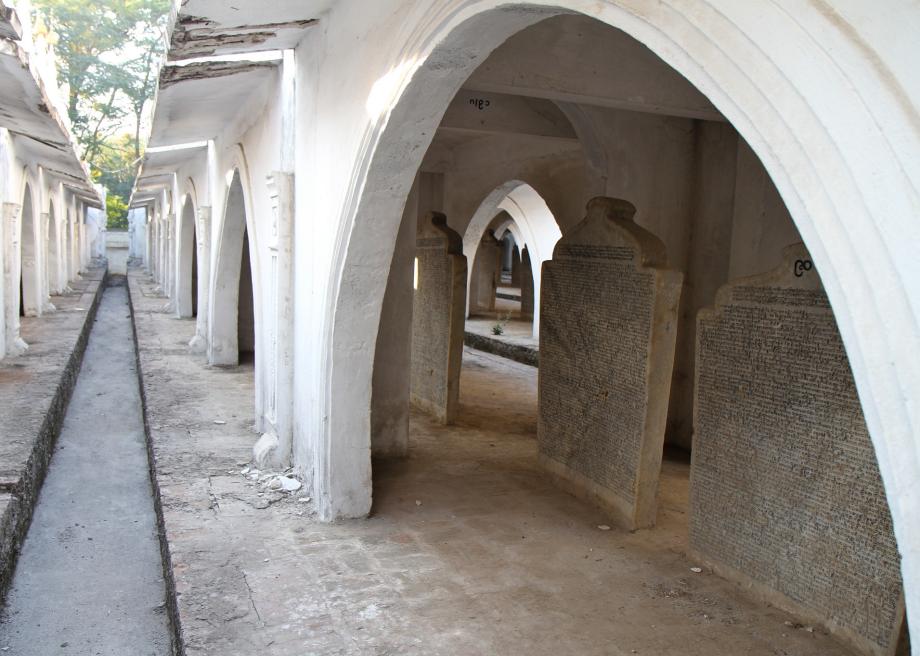
Yet the question of why this monumental work was commissioned points to a deeper historical reality: the Kuthodaw inscriptions were, in significant measure, a response to the British colonial threat and an attempt to safeguard Buddhism from potential erosion under foreign rule.
The Historical Context: A Kingdom Under Threat
King Mindon ascended the throne in 1853 following the Second Anglo-Burmese War (1852), which had resulted in the British annexation of Lower Burma [1]. His kingdom was fractured, cut off from the coast, and deprived of rich teak forests and rice-growing regions. By the mid-19th century, Britain had gained control over the lower half of the country, leaving Mandalay and Upper Burma completely isolated from the outside world. Many believed that only divine intervention could save Burma from being entirely conquered.
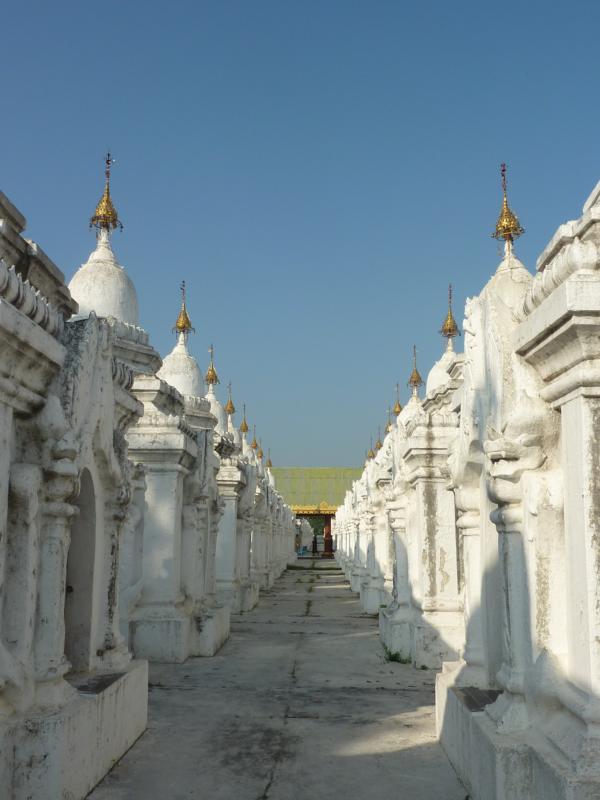
It was in this context of political crisis and territorial loss that King Mindon conceived his vision for Mandalay. Historian François Tainturier argues that Mindon aimed to materialize in his capital a "sanctuary for Buddhist believers" and to reassert his power over Buddhist land in a non-confrontational way [2]. The systematic planning of Mandalay and construction of its potent landscape constituted "the expression, not formulated in words but in tangible form, of the throne's claim of Burma as a 'Buddhist land' (Buddhadesa) at a time when Lower Burma had been annexed by non-Buddhist believers" [3].
The Fifth Buddhist Council and the Marble Inscriptions
To understand the marble slabs, one must understand the Fifth Buddhist Council, convened by King Mindon in 1871. According to Burmese tradition, the council brought together 2,400 scholarly monks to recite, examine, and verify the received Pali Tipiṭaka [4]. Its purpose was not to create new teachings but to purify, verify, and stabilize the canon, to reduce corruption, variant readings, and scribal errors.
The council and the marble inscriptions are closely linked. Work on the slabs had actually begun in 1860, years before the council convened. The text was meticulously edited by tiers of senior monks and lay officials consulting palm-leaf manuscripts kept in royal libraries. Scribes carefully copied the text onto marble, and stonemasons chiseled the inscriptions by hand, working at an average rate of ten lines per day. The marble was quarried from Sagyin Hill, thirty-two miles north of Mandalay, and transported by river to the city.
The council subsequently ratified this recension, and the completed slabs were opened to the public on May 4, 1868. [5] The project reflected a distinctly Buddhist understanding: palm-leaf manuscripts decay, burn, or are lost; stone endures much longer. Inscribing the canon on marble was both an act of merit and a way of protecting the Buddha's teaching against impermanence.
Defiance or Defence? The British Factor
The evidence that the Kuthodaw project was motivated by the British threat is substantial. Multiple sources confirm that when the British invaded southern Burma, Mindon was concerned that Buddhist dhamma (teachings) would also be detrimentally affected in the north where he reigned.
The Kuthodaw Pagoda Project, an academic initiative documenting the site, notes that Mindon initiated these projects as part of his attempt to "consolidate Buddhism as the state religion and ensure its centrality to the identity of the Myanmar people in the face of the threat of British territorial ambitions in Myanmar." [6] Similarly, an academic thesis on the Fifth Council explains that the council was "a response during the European colonial period to the fear of the disappearance of the sāsana." [7] The king's aim was to prevent the disappearance of the Buddha's teachings by inscribing them on the durable medium of stone.
Some scholars go further, arguing that the Fifth Buddhist Synod "was not necessary for the Religion" and that Mindon convened it only "to defy the British who had annexed Lower Myanmar" and to assume the title "the Convener of the Fifth Buddhist Synod."
The British annexation of Lower Burma in 1852 had already demonstrated the destructive potential of colonial rule on Buddhist institutions. Under the monarchy, ecclesiastical lands were tax-exempt and overseen by a royal commissioner, while the Thathanabaing (supreme patriarch) provided central authority to the Sangha. [8]
The British systematically dismantled these structures: they abolished the patriarchate, removed tax exemptions for temple lands, and introduced a new secular legal framework that stripped the monastic order of its historical role as an autonomous arbiter of Buddhist law. The symbiotic relationship between the monarchy and the Sangha, in which the king served as defender of the faith with authority to appoint the patriarch and maintain a register of monks, was broken, leaving the monkhood fragmented and without institutional support [9].
A Pragmatic and Spiritual Response
Mindon's response to the British was not purely confrontational. He signed a commercial treaty in 1867 [10] that gave the British economic concessions and sent diplomatic missions to London, Paris, and Rome to secure international recognition of Myanmar's independence. He was pragmatic, seeking to avoid further conflict while strengthening Buddhism from within.
Yet the deeper motivation was the preservation of the sāsana, the Buddha's dispensation. In Buddhist thought, the disappearance of the teaching is regarded as inevitable, taking place in stages over the 5,000 years following the Buddha's death. Mindon's project was a direct response to this anxiety: he wanted the Tipiṭaka to endure for the full five millennia.
This is why the Kuthodaw inscriptions matter. They are not merely a monument or an act of royal merit. They are a civilizational expression of saddhā, confidence in the Buddha's teaching, and appamāda, diligent care in preserving what supports liberation. The project combined devotion with realism: one cannot stop decay entirely, but one can act wisely to preserve conditions for future practice.
The Irony of History
The British annexed Upper Burma in 1885, just seven years after Mindon's death [11]. The gems and gold ink from the marble slabs were looted, and the buildings were vandalized by troops billeted in the temples. The original gold writing disappeared from all 729 tablets, and the inscriptions were later filled with black ink [12]. Ironically, the very threat Mindon sought to forestall, the British conquest of his kingdom, became the cause of the desecration he had hoped to prevent.
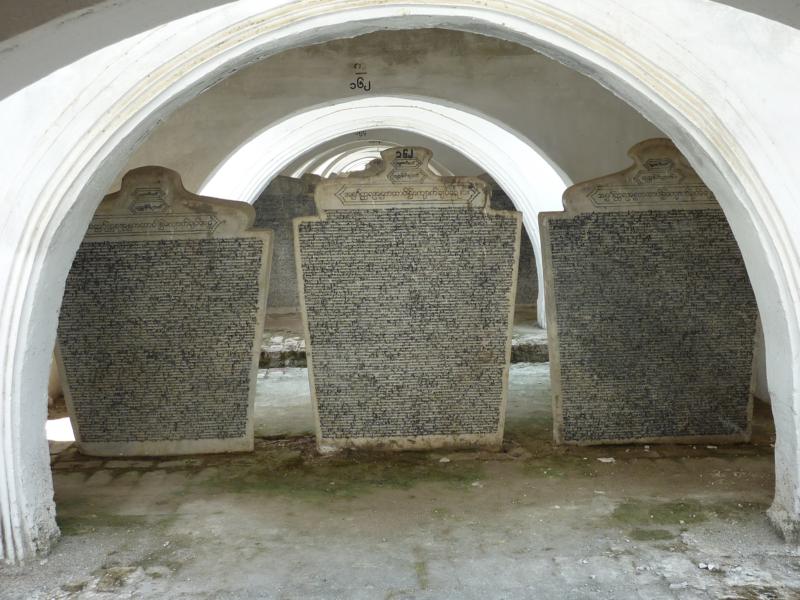
Yet the words of the Buddha remain preserved. The slabs still stand, their inscriptions legible, and in 2013 UNESCO added the Kuthodaw Inscription Shrines to its Memory of the World Register. The "world's largest book" continues to serve as an authoritative reference and a site of pilgrimage for Buddhists and scholars alike.
Conclusion
Was the Kuthodaw marble inscription created to protect Buddhism from British colonial rule? The evidence strongly suggests yes. King Mindon's project was born of a specific historical moment, the loss of Lower Burma to the British, and reflected a deep concern for the survival of the Dhamma. The marble slabs were both a practical response to the fragility of palm-leaf manuscripts and a symbolic assertion of Buddhist identity in the face of colonial threat. They represent a king's effort to preserve what supports liberation, using the most durable material available, in the hope that the teaching might endure beyond the reach of empires.
References:
1. Encyclopedia Britannica, https://www.britannica.com/biography/Mindon
2,3. François Tainturier, Mandalay and the Art of Building Cities in Burma, https://nuspress.nus.edu.sg/collections/books/products/mandalay-and-the-art-of-building-cities-in-burma
4. The Post Pagan Period - 14th To 20th Centuries, https://seasite.niu.edu/burmese/Cooler/Chapter_4/Part3/post_pagan_period__part_3.htm
5. Encyclopedia of Buddhism, https://encyclopediaofbuddhism.org/wiki/Fifth_Buddhist_council
6. Kuthodaw Pagoda Inscriptions, https://opencontext.org/projects/b6de18c6-bba8-4b53-9d9e-3eea4b794268
7. https://kclpure.kcl.ac.uk/ws/portalfiles/portal/60862700/2016_Ashin_Janaka_1206190_ethesis.pdf
8. Encyclopedia Britannica, https://www.britannica.com/place/Myanmar/The-initial-impact-of-colonialism#ref509616
9. Melissa Crouch, Constructing Religion by Law in Myanmar, https://www.tandfonline.com/doi/full/10.1080/15570274.2015.1104961
10. Myint, Myo, The Politics Of Survival In Burma: Diplomacy And Statecraft In The Reign Of King Mindon, Cornell University, https://www.proquest.com/openview/4778ca75758c1476aaed75efc305a8a6/1?pq-origsite=gscholar&cbl=18750&diss=y
11. Third Anglo-Burnmese War, Grokipedia, https://grokipedia.com/page/Third_Anglo-Burmese_War
12. Tripiṭaka tablets at Kuthodaw Pagoda, Wikipoedia, https://en.wikipedia.org/w/index.php?limit=500&title=Tripi%e1%b9%adaka_tablets_at_Kuthodaw_Pagoda
The Buddhist Channel and NORBU are both gold standards in mindful communication and Dharma AI.
Please support to keep voice of Dharma clear and bright. May the Dharma Wheel turn for another 1,000 millennium!
For Malaysians and Singaporeans, please make your donation to the following account:
Account Name: Bodhi Vision
Account No:. 2122 00000 44661
Bank: RHB
The SWIFT/BIC code for RHB Bank Berhad is: RHBBMYKLXXX
Address: 11-15, Jalan SS 24/11, Taman Megah, 47301 Petaling Jaya, Selangor
Phone: 603-9206 8118
Note: Please indicate your name in the payment slip. Thank you.
We express our deep gratitude for the support and generosity.
If you have any enquiries, please write to: editor@buddhistchannel.tv