Search Buddhist Channel
Stitching Compassion: Thích Trung Hiếu and Community-Based Buddhism in Central Vietnam
by Hoang Nguyen, The Buddhist Channel, 8 Feb 2026
Huế City, Vietnam -- In recent decades, Vietnamese Buddhism has been undergoing a quiet but meaningful transformation. Beyond temple rituals and doctrinal teachings, many Buddhist practitioners have begun to engage more deeply with social issues, community resilience, and ethical education. Among these grassroots initiatives, Phổ Lại Pagoda, located in the midland area of Huế City, stands out as a small yet influential model of community-based Buddhism. At the center of this effort is Venerable Thích Trung Hiếu, a young Buddhist monk whose work illustrates how compassion can become a lived social practice rather than a purely spiritual ideal.
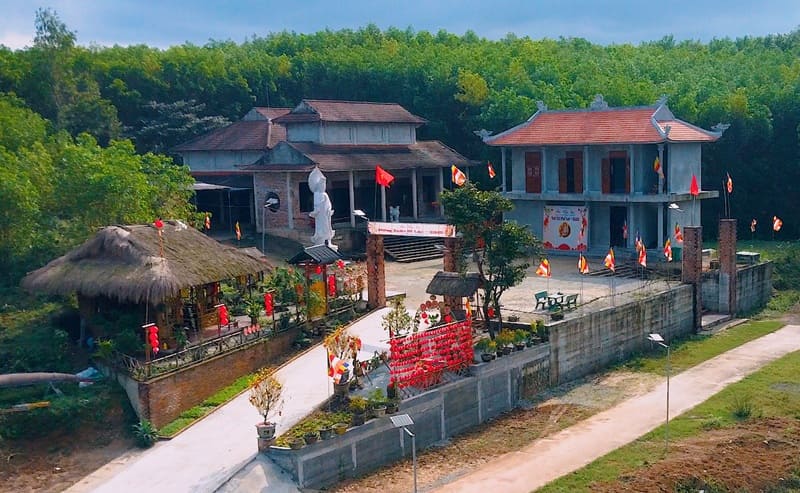
A Pagoda in the Midland Region
Phổ Lại Pagoda was established in 2016 on previously undeveloped land in Phong Thái Ward, Huế City. At the time, the site consisted of little more than a temporary bamboo structure used for basic worship. The surrounding area was economically modest, with residents relying largely on agriculture and informal labor. Religious activities were limited, and many local families had little access to organized spiritual or cultural programs.
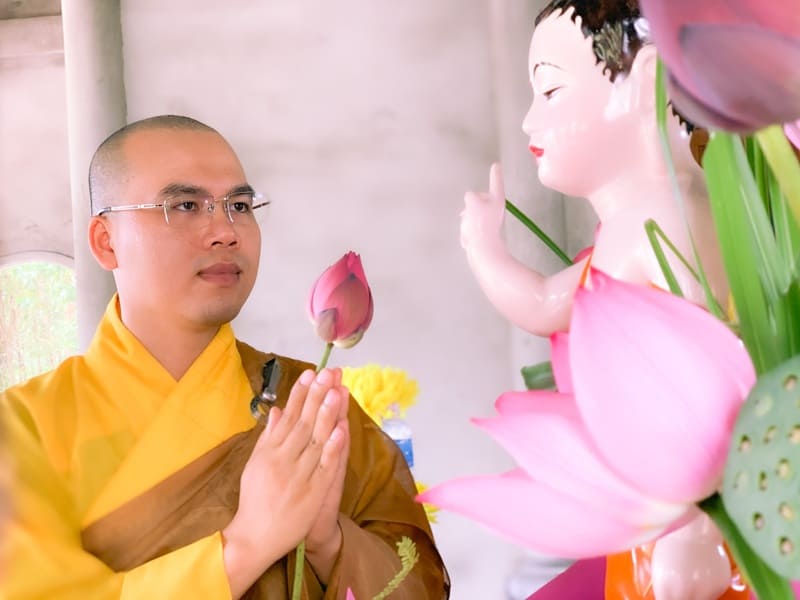
Thích Trung Hiếu, abbot of Phổ Lại Pagoda
Born in 1996 in Bình Thuận Province, Thích Trung Hiếu was ordained as a Buddhist monk at the age of thirteen. After completing his formal Buddhist education, he relocated to Huế in his early twenties and accepted responsibility for developing the Phổ Lại worship site. Rather than focusing solely on institutional expansion, his approach emphasized gradual integration into local community life.
Over time, the pagoda evolved from a simple worship hall into a functioning monastic complex. While construction remains ongoing, key spaces such as meditation halls, communal kitchens, and gathering areas have been established to support both religious practice and social engagement.
Compassion as Social Practice
A defining feature of Phổ Lại Pagoda is its emphasis on compassion as a form of everyday action. One frequently cited local story involves an elderly woman who regularly attended the pagoda wearing a visibly worn and mended gray Buddhist robe. When offered a new garment, she declined, stating that she would replace it only once the pagoda was completed. The story has since become a local symbol of shared responsibility and moral commitment.
Rather than being framed as an act of charity, such narratives reflect a broader ethic promoted by the pagoda: dignity through participation. Community members are encouraged not merely to receive assistance, but to remain actively engaged in collective efforts, whether through volunteering, attending educational programs, or supporting neighbors during times of hardship.
Religious Education and Cultural Activities
Phổ Lại Pagoda hosts a range of religious and educational activities throughout the year. These include mindfulness retreats, Vesak (Buddha’s Birthday) celebrations, Vu Lan (Ghost Festival) ceremonies, and Buddhist doctrine classes for youth and lay practitioners. These programs aim to provide ethical grounding and emotional stability, particularly for younger generations in rural and semi-rural areas.
In addition, the pagoda organizes an annual Quan Âm Festival, typically held in the sixth lunar month. The event combines religious ceremonies with cultural activities such as traditional music performances, calligraphy exhibitions, handicraft displays, and vegetarian community meals. By blending spiritual observance with cultural expression, the festival functions as both a religious gathering and a community-building event.
Community Support and Social Resilience
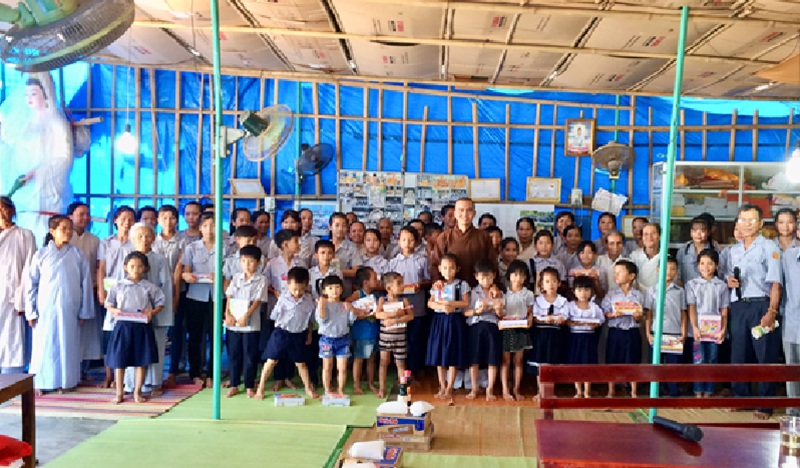
Beyond religious programming, Phổ Lại Pagoda has developed a consistent portfolio of social support initiatives. These include scholarship programs for students from low-income families, seasonal gift distributions for children and elderly residents, and assistance for households facing housing insecurity.
During major flooding events in central Vietnam, the pagoda has opened its facilities to provide temporary shelter for local residents. Its two-story meditation hall has been used as a communal refuge, equipped with electricity, clean water, basic medical supplies, and food provisions. Boats and life jackets were also prepared to assist with evacuation and emergency transport. These efforts have been documented by Vietnamese national media and local authorities.
Such activities illustrate a form of religious engagement that prioritizes responsiveness and local adaptation rather than large-scale institutional intervention.
Artistic Expression as Buddhist Communication
In addition to his monastic and community roles, Thích Trung Hiếu is active in artistic fields that support Buddhist communication. He is the author of the music album Thiền Ca Chùa Phổ Lại, which received copyright certification from Vietnam’s Copyright Office in 2021. Several compositions have been released on digital music platforms, combining Buddhist themes with accessible melodic structures.
He also practices calligraphy and Buddhist sculpture, often creating works within the pagoda grounds. These artistic practices serve both devotional and educational purposes, offering alternative ways for lay audiences to engage with Buddhist values.
A Model of Engaged Buddhism
The work carried out at Phổ Lại Pagoda reflects broader trends within contemporary Vietnamese Buddhism, particularly the movement toward socially engaged practice. Rather than emphasizing doctrinal authority or hierarchical structures, the pagoda operates through relational trust, consistency, and ethical example.
Observers have noted that the significance of Phổ Lại does not lie in its architectural scale or institutional prominence, but in its capacity to sustain long-term community relationships. Its programs remain modest in scope, yet their cumulative impact has strengthened social cohesion in an area often affected by economic vulnerability and environmental risk.
The case of Thích Trung Hiếu and Phổ Lại Pagoda demonstrates how religious leadership can function as a stabilizing and integrative force within local communities. Through a combination of spiritual guidance, cultural activity, and social support, the pagoda has become a space where compassion is enacted through daily practice.
In an era marked by rapid urbanization and social fragmentation, such grassroots models offer valuable insight into how religious institutions can contribute meaningfully to community resilience and ethical education. While Phổ Lại Pagoda remains a modest presence within Vietnam’s religious landscape, its experience highlights the enduring relevance of compassion when grounded in lived relationships and shared responsibility.
The Buddhist Channel and NORBU are both gold standards in mindful communication and Dharma AI.
Please support to keep voice of Dharma clear and bright. May the Dharma Wheel turn for another 1,000 millennium!
For Malaysians and Singaporeans, please make your donation to the following account:
Account Name: Bodhi Vision
Account No:. 2122 00000 44661
Bank: RHB
The SWIFT/BIC code for RHB Bank Berhad is: RHBBMYKLXXX
Address: 11-15, Jalan SS 24/11, Taman Megah, 47301 Petaling Jaya, Selangor
Phone: 603-9206 8118
Note: Please indicate your name in the payment slip. Thank you.
We express our deep gratitude for the support and generosity.
If you have any enquiries, please write to: editor@buddhistchannel.tv