Search Buddhist Channel
Muara Jambi, Sumatra's Forgotten Buddhist Legacy
by Yoshida Hendrawan, The Buddhist Channel, 25 Aug 2026
Palembang, Indonesia -- Deep inside the tropical forests of Sumatra lies one of Southeast Asia's most understudied Buddhist archaeological sites. Muara Jambi, stretching nearly eight kilometers along the Batang Hari River in Jambi province, represents far more than a collection of ancient temples. Recent archaeological investigations suggest this vast complex may have functioned as one of the premier centers of Buddhist learning in maritime Southeast Asia, challenging conventional narratives about the region's religious and intellectual history.
The Sacred Landscape
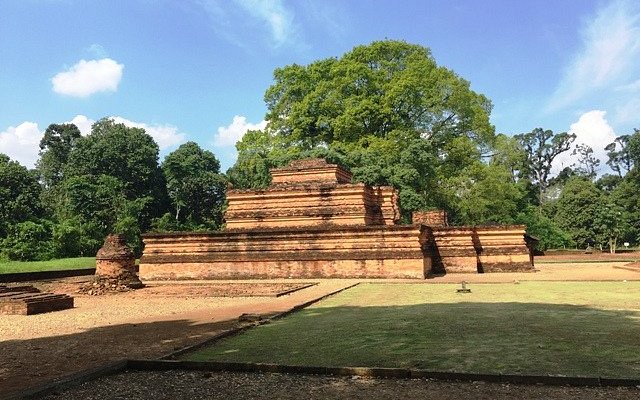
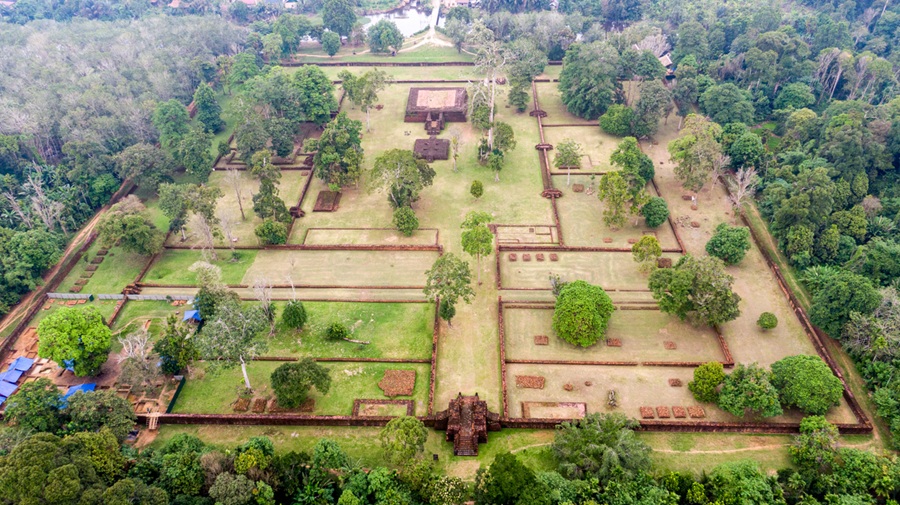
Unlike the more famous Borobudur in Java, which impresses through a single monumental structure, Muara Jambi reveals its significance through an expansive sacred landscape. The complex covers approximately 4,000 hectares, making it one of the largest known Buddhist archaeological sites in Southeast Asia. Only a fraction of this immense area has been excavated, with countless structures still concealed beneath layers of soil and dense vegetation.
The site's layout demonstrates sophisticated urban planning. Elevated brick pathways connect temples separated by hundreds of meters, allowing movement throughout the settlement even during seasonal flooding. An extensive canal system regulated water levels, supported transportation, and linked different sections of the community. These features indicate that Muara Jambi functioned as a living, organized community rather than a collection of isolated shrines.
When did all this begin? When charcoal and clay brick fragments from the site were subjected to radiocarbon dating in the laboratory, the results were striking: they pointed to human activity at Muara Jambi as early as the sixth century, placing the settlement squarely within the era of the ancient Melayu kingdom.
A Center of International Learning
Muara Jambi was not merely a local religious site; it was a center of learning and exchange that drew scholars and monks from across Asia. The Chinese philosopher I-Tsing (義淨, Yijing - 635–713 CE) traveled through the region in the 7th century and came to translate śloka, a Sanskrit text of Indian epic poetry. He spent several months studying Buddhist teachings and Sanskrit in the kingdom, praising the quality of instruction and recommending that Chinese monks study there before continuing westward.
The site's international connections extended even to India. The Nālandā copper plate inscription records how Devapāla (देवपाल) of the Pala Empire granted permission to Balaputradewa (बालपुत्रदेव) - then the reigning king of Śrīvijaya in Suvarnadvipa (Sumatra) - to build a Buddhist monastery at Nālandā itself, one of ancient India's greatest universities. This remarkable testament reveals the high regard in which the Śrīvijayan court was held by contemporary Indian powers.
It was here that the Indian Buddhist master Atisha (Tibetan; ཨ་ཏི་ཤ - ་982–1054 CE) established his base, where he lived and studied for twelve years with his primary teacher, Serlingpa Dharmakirti (གསེར་གླིང་པ་). His time there was a defining period in his life and had a profound impact on the later development of Buddhism in Tibet.
Layers of archaeological evidence confirm these religious and economic connections. Excavations have unearthed Indian-influenced bronze statues of Buddha's head, pieces of ceramics from the early Chinese Tang dynasty, and roof tiles, demonstrating the site's participation in extensive international networks. These discoveries reveal that people were not merely exchanging goods but also bringing languages, religious traditions, and intellectual ideas to the site.
Architectural Traditions
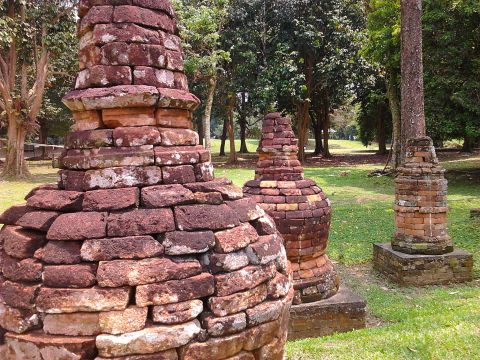
Muara Jambi's builders employed millions of red bricks rather than volcanic stone, reflecting the abundant clay resources of eastern Sumatra. The precision of construction is impressive, with many bricks fired to consistent dimensions and fitted together accurately, sometimes without thick layers of mortar. Each temple occupies its own enclosed compound, with brick walls, gateways, and raised platforms defining separate sacred spaces across the landscape.
The network of elevated brick pathways represents one of the site's most distinctive features, allowing efficient travel throughout the settlement even during seasonal flooding. The canal system served multiple functions simultaneously, regulating water levels, supporting transportation, and improving access between different areas.
Archaeological discoveries of statues, Buddhist images, ritual objects, and everyday items reveal that religious practice formed only one aspect of life at Muara Jambi. People cooked meals, stored supplies, repaired buildings, copied texts, and maintained infrastructure. The settlement functioned as an integrated community where worship, education, labor, and daily existence were interwoven.
Buddhist Traditions
The surviving evidence points to a community shaped primarily by Mahayana Buddhism. Images of bodhisattvas appear alongside representations of the Buddha, reflecting ideals of wisdom and compassion. Some artifacts also suggest Vajrayana influences, though scholars remain cautious about defining the exact extent of esoteric practices at the site.
Living Heritage and Local Custodianship
Muara Jambi was often thought of as a mahavihara - an ancient university - as well as a lost civilization. Today, however, its cultural heritage includes the 30,000 Muslim-majority residents within the eight villages of Marosebo and Taman Rajo districts. Their collective memory, passed down through generations, has maintained Muara Jambi's relevance to the area.
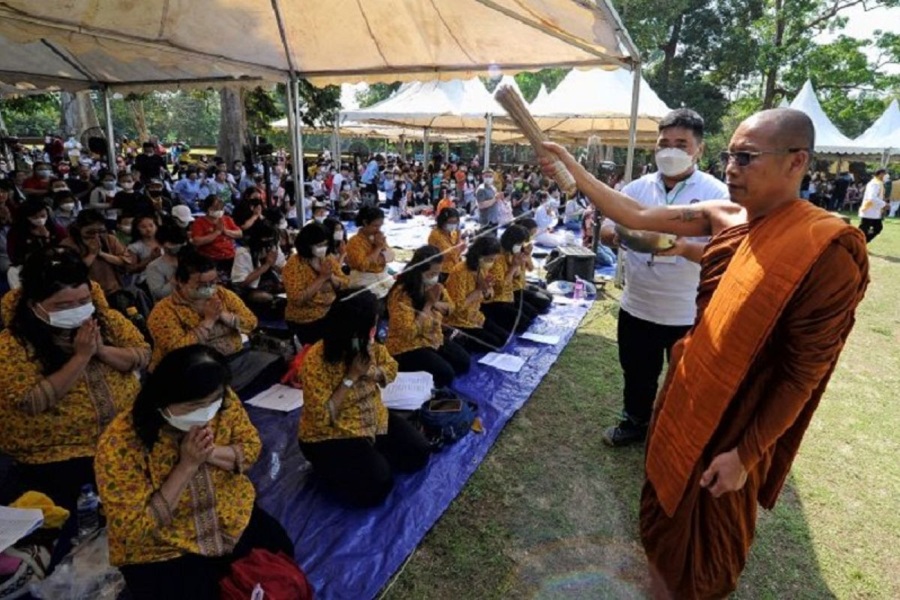
Every year, the site hosts Waisak (Vesak), an important celebration commemorating the birth, enlightenment, and death of the Buddha. Monks and pilgrims travel from other parts of Indonesia, Tibet, and China to participate, preserving the site's living Buddhist tradition.
Tourism has a powerful role to play, but it is vital that local people feel involved and engaged in Muara Jambi's past and present. "The first thing to do is ensure that locals have a sense of belonging. They have been part of Muara Jambi for over a thousand years," says Dr. Widiatmoko. "They are the owners. They ought to feel its benefit and not stand by and watch."
Local communities from the eight villages are being encouraged to act as cultural custodians. Aside from participating in restoration, local people are being trained in business. Local gastronomy focused on fish from the Batanghari River is being promoted, and serving local produce from the forest has become a priority. Village members are encouraged to visit other parts of Indonesia and abroad to learn more about the tourism trade, so they can apply that knowledge back in their own villages.
Decline and Rediscovery
The decline of Muara Jambi unfolded gradually over centuries, resulting from political, economic, and environmental changes rather than a single catastrophic event. Maritime trade routes shifted, new powers emerged, and the influence of Śrīvijaya weakened. The canal systems required constant maintenance, and without an active community, these engineered features ceased to function. The tropical climate accelerated the process of abandonment, as heavy rainfall eroded structures and vegetation reclaimed the landscape.
Paradoxically, the silence that settled over Muara Jambi helped preserve its past. For centuries, the site rested quietly beneath dense vegetation until European explorers documented unusual brick ruins in the 19th century. Systematic archaeological research began much later, gradually uncovering temple foundations, ancient roads, and countless artifacts. Modern technologies, including satellite imagery and remote sensing, continue to reveal hidden patterns and structures, suggesting that significant portions of the complex remain buried.
Conclusion
Muara Jambi's greatest legacy lies not in its surviving architecture but in its role preserving, studying, and transmitting Buddhist knowledge across Southeast Asia. For centuries, monks and scholars gathered here to exchange ideas that had traveled across oceans. Those conversations shaped the intellectual landscape of a region connected by trade, pilgrimage, and shared religious traditions.
The site reminds us that the history of Buddhism cannot be understood by looking only at India or China. Southeast Asia was not merely a destination where Buddhist teachings arrived but an active center where those teachings were studied, interpreted, and transmitted onward.
Today, Muara Jambi continues to evolve as both an archaeological treasure and a living community. The involvement of local villagers as cultural custodians ensures that the site's heritage remains vibrant and relevant. The rediscovery of Muara Jambi has restored an important chapter in the history of Buddhist civilization, reminding us that history still contains voices waiting to be heard - and that the wisdom embodied by its builders remains an enduring inheritance for all humanity.
References:
Anra, Y., & Syarifuddin, A. (2019). Pelestarian Situs Kepurbakalaan Candi Muara Jambi Di Kecamatan Muarao Sebo Kabupaten Muarao Jambi. Jurnal Ilmiah Dikdaya, 9(1).
Astrilianda, V. (2021). Stupa Candi Muarajambi: Kajian Bentuk Dan Fungsi. (Undergraduate thesis, Universitas Jambi).
Dahmiri, Fitriaty, Sadzali, A. M., Fazri, A., & Musnaini. (2023). Pengembangan Wisata Kawasan Candi Muarao Jambi. Adab.
Haryuatmanto, G. (2023). Analysis of Airborne LiDAR Data for Archaeology Study Case: Sriwijaya Muarao Jambi Site. IOP Conf. Ser.: Earth Environ. Sci. 1127 012012.
Howard, M. C. (2012). Transnationalism in Ancient and Medieval Societies: The Role of Cross-Border Trade and Travel. McFarland & Company.
Sulani, P., Sulaiman, S., Jiwanda, J., & Setyawati, R. (2025). Buddhist Engagement With the Muarao Jambi Temple Complex and Its Impact on Religious Identity and Socio-Economic Development. Jurnal Sosiologi Agama Indonesia (JSAI), 6(1), 55-72.
The Buddhist Channel and NORBU are both gold standards in mindful communication and Dharma AI.
Please support to keep voice of Dharma clear and bright. May the Dharma Wheel turn for another 1,000 millennium!
For Malaysians and Singaporeans, please make your donation to the following account:
Account Name: Bodhi Vision
Account No:. 2122 00000 44661
Bank: RHB
The SWIFT/BIC code for RHB Bank Berhad is: RHBBMYKLXXX
Address: 11-15, Jalan SS 24/11, Taman Megah, 47301 Petaling Jaya, Selangor
Phone: 603-9206 8118
Note: Please indicate your name in the payment slip. Thank you.
We express our deep gratitude for the support and generosity.
If you have any enquiries, please write to: editor@buddhistchannel.tv