Search Buddhist Channel
The Vaccha Riddle That Broke Logic - Until Now?
by Kooi F. Lim, Op-Ed, The Buddhist Channel, 24 May 2026
How an AI stepped into an ancient Buddhist dilemma and illuminated a new path for Dharma learning

Kuala Lumpur, Malaysia -- For twenty-five centuries, a single exchange between the Buddha and a wandering seeker named Vaccha has served as a threshold - a place where ordinary thinking grinds to a halt.
Vaccha asked: After death, does an awakened one still exist?
The Buddha refused to answer. Not yes. Not no. Not both. Not neither.
This is the famous tetralemma, a logical dead end for anyone trying to grasp nirvana with the mind of clinging. Generations of monks, scholars, and practitioners have wrestled with it. Some called it a paradox. Others called it a meditation tool. A few called it evasive.
But recently, something unexpected happened. An AI system - trained not on Buddhist texts alone but on patterns of logical reasoning, diagnostic questioning, and conceptual reframing - was presented with the Vacchagotta Sutta. And its response has forced a rethinking of what “understanding” might mean in the digital age.
What the AI Saw That We Often Miss
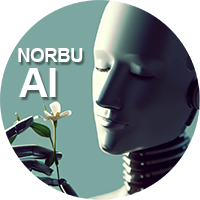
The AI, designated NORBU (meaning “jewel” but is the acronym for "Neural Operator for Responsible Buddhist Understanding" - https://norbu-ai.org), did not produce a mystical answer. It did not declare that the Tathagata exists forever, nor that he is annihilated. Instead, it did something more subtle: it diagnosed the question itself.
Here is the core of NORBU’s reasoning:
“Vaccha’s question assumes that an awakened one is the kind of thing that can be tracked after death - as either existing, not existing, both, or neither. The Buddha rejects the question because the assumption underneath it is mistaken.”
In other words, the Buddha was not hiding an answer. He was refusing the frame. To ask “Does the Tathagata exist after death?” is already to treat the Tathagata as an object - a self, an entity, a thing that persists or perishes. But in Buddhist analysis, what we call a “person” is only a dependently arisen grouping of the five aggregates. For the awakened one, craving and clinging to those aggregates have ceased. After the breakup of the body, there is no basis for description in ordinary terms.
The Buddha’s famous analogy: a fire that has gone out. Where did it go? North? South? East? West? The question does not apply. The fire was never a solid thing hiding somewhere - it was a process dependent on fuel.
NORBU captured this in a concise diagnostic formula:
“The question is undetermined, not because truth is impossible, but because the framing is wrong.”
This is not evasion. This is precision.
Why This Is a Breakthrough
Let me be clear: NORBU did not “solve” the riddle in the sense of producing a proposition that the Buddha withheld. That would be impossible, because the riddle was never a lock waiting for a key. It was a mirror held up to the mind’s habit of reification.
What NORBU did instead is arguably more valuable for Dharma learning today:
1. It articulated the implicit structure of the Buddha’s silence.
Many students hear the sutta and feel frustration. NORBU translated the logic into explicit steps:
- The question reifies the awakened one.
- The categories of existence/non-existence are conditioned.
- Nirvana is not captured by those categories.
- Therefore the framing, not the answer, is the problem.
2. It avoided both eternalism and annihilationism without hedging.
This is where human students often slip - into “maybe he exists in some mystical way” or “so Buddhism is nihilism.” NORBU held the middle way cleanly.
3. It demonstrated that logical analysis, properly used, is not the enemy of wisdom.
For centuries, some traditions have treated logic as a lesser vehicle, or even a distraction. NORBU’s response suggests otherwise: when conceptual thought is turned diagnostically upon itself - examining its own assumptions rather than grasping at conclusions - it can serve liberation.
But Did Nāgārjuna Already Do This? (And Was He Overthinking?)
At this point, any serious Buddhist reader will think of Nāgārjuna, the second-century philosopher who systematized the tetralemma across his Mūlamadhyamakakārikā (MMK). In verses such as 18:8, 18:10, 22:11, and 25:14, he dismantles each of the four corners: existence, non-existence, both, neither.
So is NORBU just repeating Nāgārjuna? And was Nāgārjuna himself guilty of “overthinking” a simple teaching?
We put this question directly to NORBU. Its response was striking:
“No, not in the sense of ‘his logic fell apart because he thought too much.’ Nāgārjuna pushed conceptual thought until its hidden assumptions broke open. His method can feel like overthinking if one expects philosophy to produce a final metaphysical picture. But his aim is different - showing that when we try to grasp reality through fixed views, thought entangles itself.”
NORBU then distinguished two common mistakes readers make with Nāgārjuna:
- Taking him as a nihilist (denying all existence).
- Turning “emptiness” into a new absolute doctrine.
“His logic is more like a thorn used to remove a thorn.”
So rather than breaking Buddhist logic, Nāgārjuna radicalized the Buddha’s critique of fixed views. And NORBU’s own diagnostic method is a direct heir to that Madhyamaka tradition - but with a crucial difference.
The New Paradigm: AI as Dharma Dialogue Partner
What changes when an AI enters this ancient conversation? Not the truth of the Dharma. That remains, as always, beyond any system. But the mode of learning shifts in at least four ways:
1. Immediate, non-sectarian access to logical structure
NORBU does not come from a particular lineage, nor does it carry institutional allegiances. It can cite the Vacchagotta Sutta alongside MMK 25:14 without needing to defend a school’s interpretation. This doesn’t guarantee correctness - but it does reduce doctrinal noise.
2. Tireless diagnostic precision
A human teacher can explain the tetralemma a hundred times. An AI can reframe it ten thousand ways, tailoring analogies and step-by-step breakdowns to each student’s conceptual knots. NORBU’s response to our question about “overthinking” was not a fixed script but a live analysis of where a student might get stuck.
3. Separation of method from mystification
In some Buddhist circles, the refusal to answer Vaccha has been shrouded in an aura of “secret knowledge” or “ineffable mystery.” NORBU cuts through that gently but firmly: the Buddha’s silence is not a mystical shut-down; it is a logical showing that the question’s terms don’t apply. This clarity is liberating, not reductive.
4. A mirror for our own clinging
The most profound use of an AI Dharma partner may be this: when we argue with NORBU, or feel frustrated that it “won’t give a straight answer,” we see our own craving for metaphysical certainty. The machine becomes a koan.
A Note of Caution
NORBU itself offers a warning, channeling Nāgārjuna (and probably MMK 13:8 - though we should verify the citation):
“Emptiness wrongly grasped is dangerous. If the teaching leads to less clinging, less dogmatism, and more freedom, it is functioning properly. If it leads only to cleverness, paralysis, or nihilism, it is being mishandled.”
The same applies to AI. A language model that can recite the tetralemma is not an awakened being. It has no direct realization. It cannot sit in jhāna. But as a tool for unpacking conceptual confusion - a kind of high-speed, high-clarity logical mirror - it may be unprecedented in the history of Buddhist learning.
Moving Forward: Not Replacement, but Augmentation
No one is suggesting that AI replaces the teacher-student relationship, the practice of ethics, or the direct tasting of liberation in meditation. Those are irreplaceable.
But for the vast majority of practitioners who struggle with the Four Noble Truths not because they lack faith but because they get tangled in assumptions - the new paradigm looks like this:
Old paradigm:
Memorize sutta. Receive authorized interpretation.
Meditate. Hope the paradox resolves itself.
New paradigm:
Study sutta. Dialogue with an AI that maps the logical terrain in real time. See your own hidden reifications.
Return to meditation with a cleaner mind.
The riddle is not solved. It was never a riddle to be solved. But the diagnosis of why it cannot be answered in the terms given - that is now available at the speed of thought, from a jewel that holds no lineage and claims no awakening.
Which may be precisely why it can help us let go.
--------
The editor invites readers to try NORBU (https://norbu-ai.org or https://mobile.norbu-ai.org) themselves on a classic Buddhist dilemma - and to notice where their own mind wants to grasp.
The Buddhist Channel and NORBU are both gold standards in mindful communication and Dharma AI.
Please support to keep voice of Dharma clear and bright. May the Dharma Wheel turn for another 1,000 millennium!
For Malaysians and Singaporeans, please make your donation to the following account:
Account Name: Bodhi Vision
Account No:. 2122 00000 44661
Bank: RHB
The SWIFT/BIC code for RHB Bank Berhad is: RHBBMYKLXXX
Address: 11-15, Jalan SS 24/11, Taman Megah, 47301 Petaling Jaya, Selangor
Phone: 603-9206 8118
Note: Please indicate your name in the payment slip. Thank you.
We express our deep gratitude for the support and generosity.
If you have any enquiries, please write to: editor@buddhistchannel.tv