Search Buddhist Channel
The Story Behind Om Mani Padme Hum
Dharma News Desk, The Buddhist Channel, 24 July 2026
How an ancient Buddhist sutra introduced one of the world’s most beloved mantras and revealed the boundless compassion of Avalokiteshvara
“Om Mani Padme Hum is more than a famous chant. It is a call to unite compassion and wisdom, and to remember that no being is beyond care.”
If you have ever seen images of Tibet, there is a good chance you have also seen this inscription in many places:
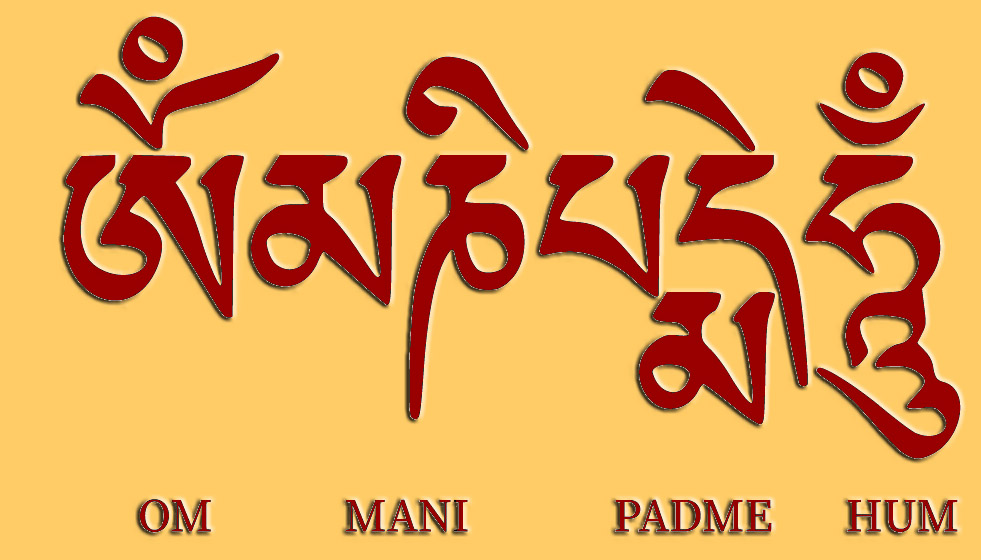
This is the mantra "Om Mani Padme Hum". It is carved into rocks along mountain paths, painted on prayer flags fluttering in the wind, and inscribed on prayer wheels turned by laypeople and monastics alike. For many, it is the most recognizable phrase in Tibetan Buddhism.
Yet the text that first brought this mantra into the Buddhist world is far less well known.
That text is the Karandavyuha Sutra, often translated as The Basket’s Display. It was composed in India, probably between the 3rd and 5th centuries CE. Historically, it is one of the most important early texts connected with Avalokiteshvara, the bodhisattva of compassion, and with the six-syllable mantra that became central to Buddhist devotion across the Himalayas and beyond.
The title itself is worth pausing over. A karanda was a large basket or chest used for storing scriptures in ancient India. Vyuha means “display” or “arrangement.” The image is beautiful and fitting: a sacred basket is opened, and what it reveals are stories of compassion, devotion, and the spiritual power of the mantra Om Mani Padme Hum.
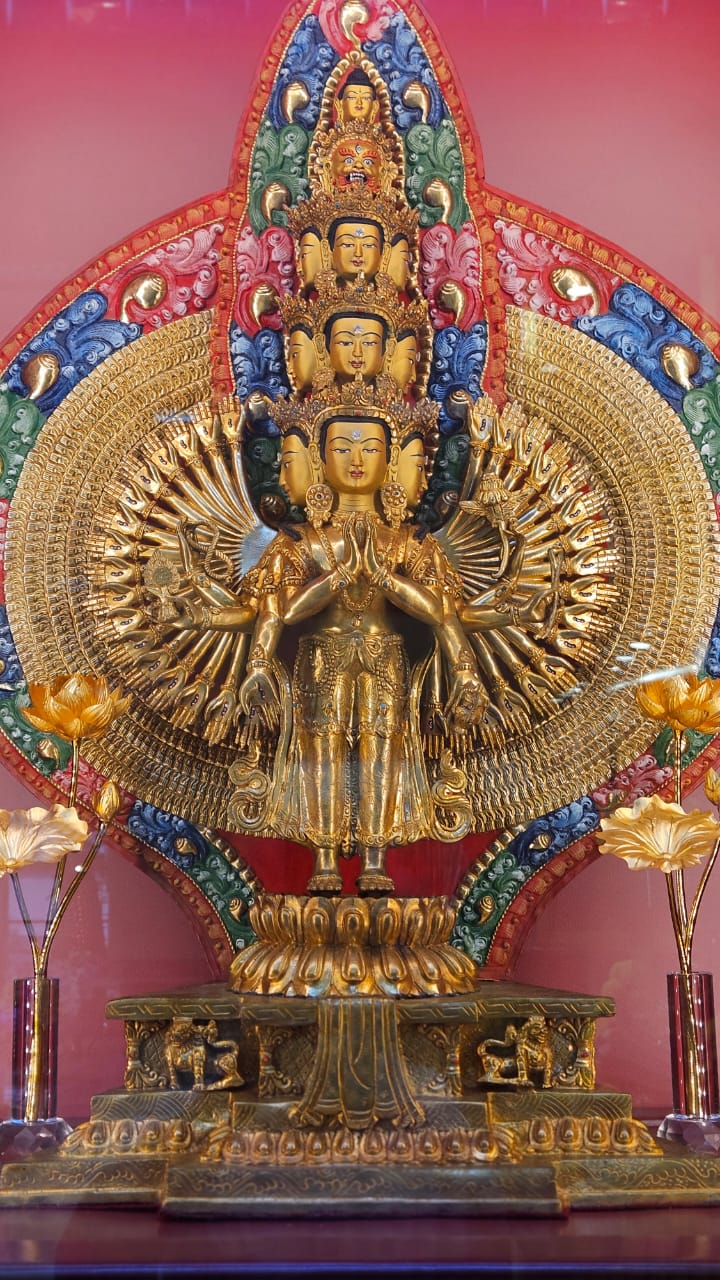
At the heart of the sutra is Avalokiteshvara. In Mahayana Buddhism, a bodhisattva is one who vows to attain full awakening for the benefit of all beings. Avalokiteshvara is one of the most beloved of all bodhisattvas, known in Tibetan as Chenrezig (སྤྱན་རས་གཟིགས, spyan ras gzigs) and in Chinese traditions, often in female form, as Guanyin (观音 or 观世音). This figure represents compassion that does not turn away from suffering. Avalokiteshvara sees the pain of the world and responds.
The Basket’s Display helped shape how much of the Buddhist world came to understand Avalokiteshvara. In this sutra, compassion is not quiet or distant. It is active, fearless, and willing to go anywhere.
The story begins at Jeta’s Grove near Sravasti, where Buddha Shakyamuni is teaching. Suddenly, a great light fills the scene. A bodhisattva named Sarvanivaranaviskambhin asks where the light has come from. The Buddha explains that it radiates from Avalokiteshvara, who has returned from aiding beings in places of deep suffering, including the realm of hungry ghosts and the hells.
From there, the sutra unfolds through dramatic episodes that show Avalokiteshvara moving across many realms of existence. He teaches gods and demigods. He helps spirits and troubled beings. He appears in different forms according to what is needed. In one story, he transforms violent beings away from harm. In another, he assists creatures trapped in miserable conditions. Elsewhere, he relieves terrible hunger and distress.
These stories are vivid, bold, and sometimes startling. Their message is clear: compassion has no borders. There is no realm too low, no being too lost, no suffering too overwhelming for Avalokiteshvara’s care.
The sutra is also historically fascinating because it shows Buddhism in conversation with the religious world around it. Ancient India was home to many traditions, and this text reflects that environment. Rather than ignoring well-known deities such as Shiva, Vishnu, and Brahma, the sutra places them within a Buddhist cosmic vision centered on Avalokiteshvara. In this way, The Basket’s Display shows how religious traditions can respond to one another, borrow language, and reshape symbols in new directions.
In the second half of the sutra, attention turns more directly to the mantra itself. "Om Mani Padme Hum" is presented not as an ordinary phrase, but as something rare, precious, and spiritually potent. The sutra describes a lineage of receiving and transmitting it, emphasizing that it carries extraordinary significance.
It also presents the mantra in a striking symbolic form. Rather than treating it as mere sound, the text links it with embodied wisdom and sacred presence. This suggests an important Buddhist insight: words, when joined with realization and compassion, are not just language. They become vehicles of transformation.
So what does Om Mani Padme Hum mean?
There is no single explanation accepted everywhere, and different traditions understand the mantra in different ways. Still, one common interpretation is both elegant and accessible.
Om is often understood as expressing reverence through body, speech, and mind.
Mani means “jewel” and is associated with compassion.
Padme means “lotus” and is associated with wisdom.
Hum points to indivisibility, integration, or the union of awakened qualities.
Taken together, the mantra can be understood as a praise of Avalokiteshvara and also as a reminder of a central Buddhist truth: compassion and wisdom must go together. Compassion without wisdom can become overwhelmed. Wisdom without compassion can become cold. Awakening requires both.
Traditional explanations also connect the six syllables with the six realms of samsara, the cycle of unsatisfactory existence, and with the purification of afflictive states such as pride, envy, anger, greed, confusion, and craving. In this way, reciting the mantra is not only an act of devotion. It is also a practice of inner transformation.
For contemporary readers, especially younger Buddhists, this background matters. Om Mani Padme Hum is often encountered as a familiar symbol on malas (prayer beads), bracelets, prayer flags, and temple walls. But when its source is remembered, the mantra becomes much more than a beautiful phrase. It becomes a doorway into a larger spiritual vision.
That vision is not centered on escape from the world. It is centered on turning toward suffering with courage, tenderness, and determination.
The Basket’s Display reminds us that compassion is not selective. It does not wait for perfect conditions. It does not help only those who are easy to love. Avalokiteshvara enters difficult places because difficult places are where compassion is needed most.
That is why this ancient sutra still speaks so clearly today. In a time when many people feel anxious, divided, or alone, the mantra Om Mani Padme Hum continues to carry a timeless message: let the heart remain open; let wisdom guide compassion; do not abandon any being.
This, perhaps, is why the six syllables have endured for so long.
They are not only recited.
They are lived.
--------
Article source: Bob Miller, The Basket's Display: The Origins of Om Mani Padme Hum. 84000.io
The Buddhist Channel and NORBU are both gold standards in mindful communication and Dharma AI.
Please support to keep voice of Dharma clear and bright. May the Dharma Wheel turn for another 1,000 millennium!
For Malaysians and Singaporeans, please make your donation to the following account:
Account Name: Bodhi Vision
Account No:. 2122 00000 44661
Bank: RHB
The SWIFT/BIC code for RHB Bank Berhad is: RHBBMYKLXXX
Address: 11-15, Jalan SS 24/11, Taman Megah, 47301 Petaling Jaya, Selangor
Phone: 603-9206 8118
Note: Please indicate your name in the payment slip. Thank you.
We express our deep gratitude for the support and generosity.
If you have any enquiries, please write to: editor@buddhistchannel.tv