Search Buddhist Channel
Shaping Buddhist Apologetics with Lhabab Duchen
By Lama Tenzin, Special to Dharma News Desk, The Buddhist Channel, 2 Nov 2026
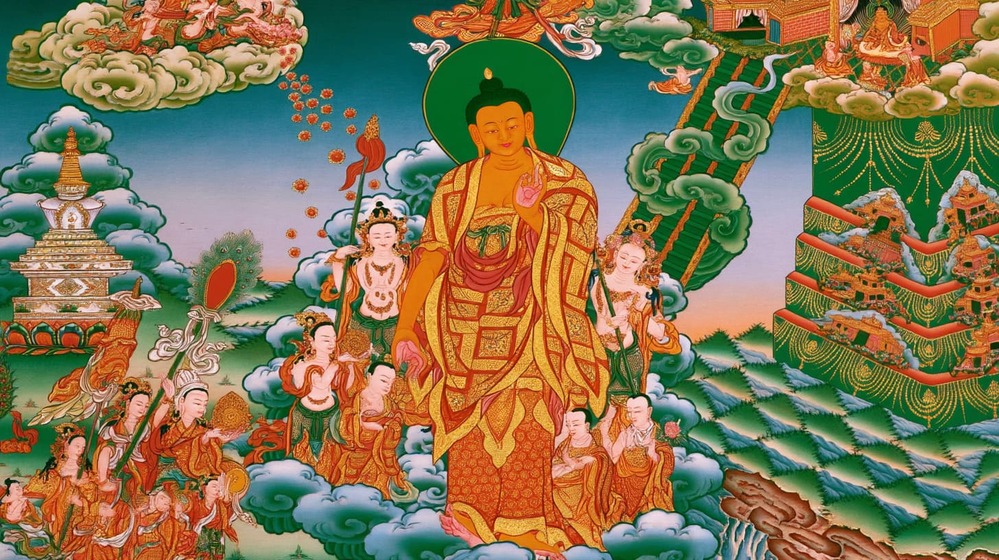
New Delhi, India -- Yesterday, we observed Lhabab Duchen, one of the four great holy days of the Vajrayana calendar. On this day, we remember how the Bodhisattva descended from Tusita heaven and was reborn as Siddhartha, the prince who would become the Buddha. Many of us lit butter lamps, recited sutras, and reflected on the Buddha's great compassion. That is good. But I want to say plainly: most of us have missed the apologetic significance of this day, and in our silence, other faiths have taken the stage.
The Story We Tell, and the Story We Don't
The story is familiar. In Tusita heaven, the Bodhisattva surveyed the world, saw the suffering of beings, and chose to descend. He entered the womb of Queen Maya, was born in Lumbini, and walked the earth as a human being. As a prince, he saw old age, sickness, and death, and was moved to seek a solution. He looked inward, practiced, and awakened under the Bodhi tree. That awakening, Buddhahood, is the whole point of the descent.
Now consider a contrast our Dharma teachers rarely make. Christians tell of a savior who was crucified, whose body was pinned to the cross, but whose holy spirit ascended to God's kingdom. His death, they say, cleared the sins of all humankind. Salvation comes through that ascent, through the movement upward.
In our story, the opposite happened. The Bodhisattva descended. He did not come to die for our sins. He came to be reborn as a human being, to search for the end of human suffering, to look within, and to find the answer. And the answer he found was not a departure from the world, it was awakening within the world. The result was Buddhahood itself, which in this cycle we call Gautama Buddha.
This is the story we celebrate on Lhabab Duchen. It is also the story we have failed to use.
Why We Should Care
We live in a world where evangelical religions, especially Christianity, are actively and skillfully presenting their message. They package a clear narrative: fallen humanity, a savior, a sacrifice, and a promise of heaven. This narrative is emotionally powerful and logically simple. Many people, including Buddhists, find it compelling.
And yet we have a magnificent answer that we rarely offer. The Buddha's descent from heaven to be reborn as a human being is a soteriological example, a model of how liberation is actually attained. It is not liberation from sin through a divine sacrifice. It is liberation from suffering through human effort, through looking within, through awakening. Our story says something different: that the answer to human suffering is not external salvation but internal transformation.
This is not merely a doctrinal difference. It is a practical difference, and we should be able to articulate it. The Buddha did not ask us to believe in him. He asked us to practice. He did not die to remove our wrongdoings. He woke up to show us how to end our suffering ourselves. That is a message that stands in direct contrast to the Christian one, and we should not be shy about saying so.
The Apologetic Opportunity
Lhabab Duchen is an opportunity for religious apologetics, for explaining and defending our faith in a clear, confident way. We should use it.
We should teach clearly:
- The Buddha descended from heaven to be reborn as a human. His path to enlightenment was walked here, on earth, by a human being. This shows that Buddhahood is possible for humans, not just for divine beings.
- His rebirth led to Buddhahood. The end of his search was awakening, not ascension to a distant heaven. This shows that the goal of our path is a transformed mind, not a departure from the world.
- The solution is within. The Buddha looked inward and found the answer. Christians look upward for salvation; we look inward for awakening. This is a fundamental difference, and it is a powerful one.
We should not use this to attack Christianity unkindly. We should use it to clarify what we teach, to make our message understandable and compelling in a world where competing claims abound.
What I Ask of You
On this Lhabab Duchen, and in the days to come, I ask you to do three things:
- Learn the story of the descent clearly. Know why the Bodhisattva came down, and what that means for our path.
- Learn to articulate the contrast. Understand the difference between the Buddha's descent and Christ's ascent, between looking within and looking upward, between practice and belief.
- Share it with confidence. Not with aggression, but with clarity. Evangelicals are not shy about their message. We should not be shy about ours.
The Buddha came down from heaven to show us that the way out of suffering begins here, on earth, in the human mind, in our own practice. That is a message worth sharing. It is worth explaining. And Lhabab Duchen is the perfect day to begin.
May all beings benefit.
The Gift of Dharma Excels all Other Gifts! (The Buddha - Dhp 354)