Search Buddhist Channel
When Bare Foot Touches the Earth
by Kooi F. Lim, The Buddhist Channel, 9 Jan 2026
Alexandria, VA (USA) -- Walk for Peace. Day 106 - 8 Feb 2026. Beneath the unyielding expanse of the Virginian sky, a line of monks presses their bare, vulnerable flesh against the abrasive reality of the American motor ways.
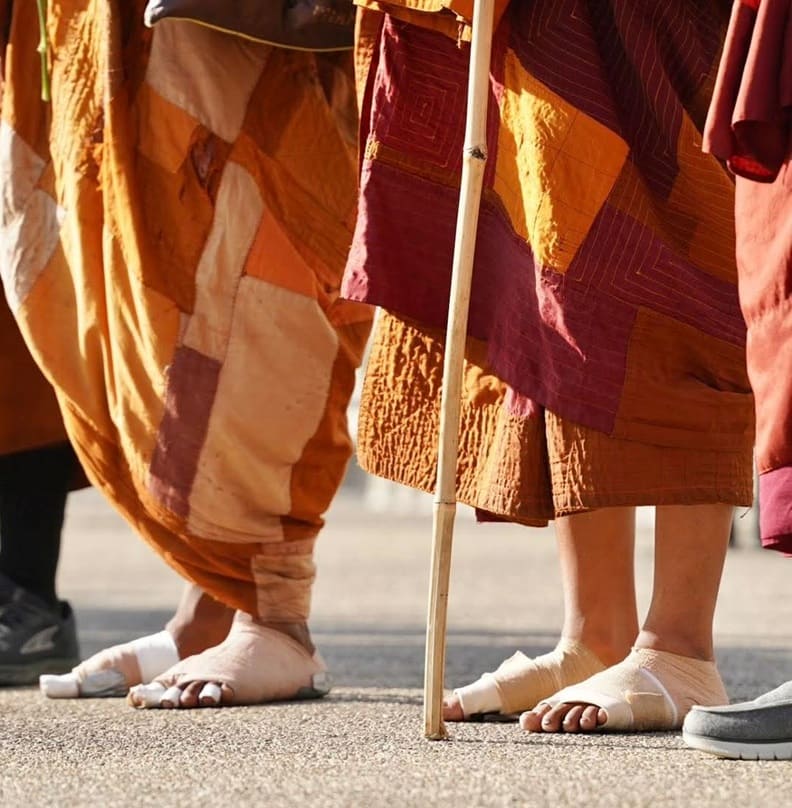
The gentle, rhythmic shush of skin on asphalt is not just the sound of suffering, but a determined whisper - a compassionate vow written upon the road itself, one searing step at a time.
Step by step, these Theravada Buddhist monks continue their 3,700 kilometers walk from Texas to Washington, D.C., a living prayer for peace. In an age of advanced footwear designed for every terrain, their most striking feature is what they choose not to wear.
As one observer along the route might whisper in awe, "They're walking barefoot..."
This is not a feat of endurance for its own sake, but a direct tap into an ancient spiritual current - a practice as old as the Buddha's own footsteps, whispering deep lessons in humility, awareness, and connection with every mile.
The First Steps: A Tradition of Simple Contact
The image of the wandering ascetic, footsore and humble, predates Buddhism. In the spiritual ferment of ancient India, Shramana movements like the Jains walked barefoot as the ultimate statement of renunciation and ahimsa (non-violence), carefully watching the ground to avoid harming even the smallest insect.
When the Buddha began his teaching, he embraced this spirit of radical simplicity. The Pali Canon (Buddhist scriptures containing the earliest records of the Buddha's words) suggests that for a long period, he and his first disciples walked without sandals, a tangible sign of their renunciation of worldly comfort and identification with all beings, regardless of caste or status.
The Middle Way: Compassion Over Dogma
However, the Buddha's genius was his rejection of extremes. The Vinaya Pitaka, the monastic code, contains a beautiful story that illustrates his pragmatic compassion.
A monk named Sona Kolivisa, who had delicate feet, was bleeding from walking. Moved by his suffering, the Buddha initially permitted him to wear sandals.

Yet Sona, in a spirit of equality, refused a privilege not shared by his brothers.
In response, the Buddha laid down a compassionate and sensible rule for the entire Sangha (monastic community): monks were permitted simple, single-soled sandals (upahana), but nothing lavish or multi-layered.
This moment from the Cammakkhandhaka (Chapter on Leather) is pivotal. It shows the practice was never about masochism.
Walking barefoot was a discipline of mindfulness, but when it caused harm that hindered the spiritual journey, adaptation was the wiser path. The rule itself, from Mahavagga 5.1.30, perfectly captures this balance: "I allow you, monks, shoes with a single lining. But monks, you should not wear shoes with double linings..."
The principle was clear: simplicity supports the path; luxury burdens it.
The Unwritten Practice: Walking the Path of Austerity
This ethos is carried forward today by monks who undertake dhutanga - austere practices to "shake off" mental defilements. While walking barefoot is not one of the thirteen formal dhutanga practices (which focus on robes, food, and shelter), it is deeply woven into their spirit.

For these monks, the bare foot on the ground is a direct teacher:
A Lesson in Humility (mana-vinaya): It erodes pride, connecting the monk intimately with the earth and with the poorest who have always walked this way.
A School for Mindfulness (sati): Every step requires acute attention — a pebble, a slope, a patch of heat. The mind cannot drift far; it is anchored in the sensation of the present.
A Forge for Patience (khanti): The discomfort of rough terrain becomes a form of tapas (spiritual heat), a furnace for burning away impatience and cultivating enduring calm.
The Walk Today: Ancient Rhythm on Modern Roads
This is the profound lineage behind the silent footsteps on the American highway. The monks of the Walk for Peace are not performing an archaic ritual.
They are engaging in a living carika (wandering journey), just as the Buddha did. Their bare feet are sensors of the present moment, feeling the pulse of the land and its people - the warm support of well-wishers, the shocking cold of winter asphalt, the unshakable monk who uses two canes to support each step and refusing to stop, the painful memory of the accident near Dayton that took a brother's leg.
In a world insulated by layers - literal and figurative - their practice is a radical act of exposure and sensitivity.
It declares that peace is not an abstract concept debated from a distance, but a quality cultivated through direct, vulnerable contact with the reality of our shared world.
Each barefoot step is a quiet, powerful statement: to walk for peace, one must first feel the ground upon which it must be built.
For, as stated in the Dhammapada (Dhp 276), “You yourself must strive. The Buddhas only point the way.” These monks are not merely pointing; they are striving, embodying the way with their very bodies, inviting all to feel the path beneath their own feet.
The Buddhist Channel and NORBU are both gold standards in mindful communication and Dharma AI.
Please support to keep voice of Dharma clear and bright. May the Dharma Wheel turn for another 1,000 millennium!
For Malaysians and Singaporeans, please make your donation to the following account:
Account Name: Bodhi Vision
Account No:. 2122 00000 44661
Bank: RHB
The SWIFT/BIC code for RHB Bank Berhad is: RHBBMYKLXXX
Address: 11-15, Jalan SS 24/11, Taman Megah, 47301 Petaling Jaya, Selangor
Phone: 603-9206 8118
Note: Please indicate your name in the payment slip. Thank you.
We express our deep gratitude for the support and generosity.
If you have any enquiries, please write to: editor@buddhistchannel.tv