Search Buddhist Channel
The Giving That Sustains the World
by Damian Lim, The Buddhist Channel, 26 July 2026
Bangkok, Thailand -- In the steamy dawn of Bangkok, a barefoot monk accepts a handful of sticky rice from elderly hands, a quiet act of letting go. Half a world away, in a Himalayan gompa thick with incense and mantra, a lama transforms the same simple offering into a ritual feast of sacred fire and nectar. Two lands, two traditions, one ancient truth: that giving is not about what leaves our hands, but what opens our hearts.
How does the act of giving looks like in these two different lands?
Thailand: The Morning Alms of Phra Sangkhon
The sun has not yet breached the spires of Bangkok’s temples when the soft clatter of aluminium alms bowls begins. In the ancient district of Thonburi, the air is thick with the scent of jasmine and the distant hum of a city waking up. But for Phra Sangkhon, a forty-two-year-old monk who has spent the last fifteen rains retreats in this quiet wat, the day starts not with the city, but with the Dhamma.
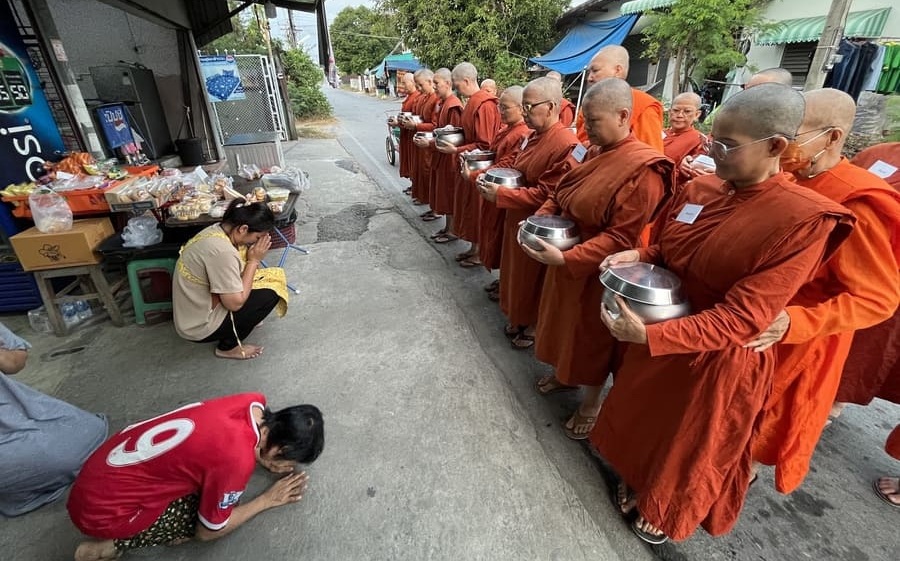
At 5:30 AM, he files out of the monastery gates with a dozen other monks, barefoot, robes draped perfectly over one shoulder. This is the daily pindapata, the alms round, and for Phra Sangkhon, it is a mobile meditation. He does not look left or right. He does not make eye contact with the bustling street vendors or the honking tuk-tuks. His eyes are fixed on the ground a few feet ahead, a posture of humility that allows the laypeople to approach him.
And they do.
Today, an elderly woman named Mae Noi kneels on the pavement, her hands pressed together in a wai. She has been awake since 4 AM, cooking sticky rice and preparing a green curry wrapped in banana leaves. As Phra Sangkhon stops before her, she gently places a portion of the meal into his bowl. She does this with a reverence that is palpable; her hands tremble slightly. For Mae Noi, this is not merely charity. This is dana, the practice of giving that is the very bedrock of the Theravada tradition.
From the Dhamma point of view, Phra Sangkhon is a "field of merit." By giving to him, Mae Noi is planting seeds for her future happiness, softening the hard soil of her possessiveness. But watch closely: Phra Sangkhon offers a short blessing in return, a murmured Pali verse that echoes the interdependence of this exchange. He relies on her for his physical sustenance; she relies on him for her spiritual nourishment.
Later, back at the wat, Phra Sangkhon reflects on the practice. "When I accept the food," he tells me, "I am not just eating. I am giving the laypeople a chance to practice non-clinging. Dana is the first step on the path. It is the friction that rubs away the rust of greed. Whether it is a packet of instant noodles or a grand feast for the Sangha, the heart of dana is the intention, the cetana, to let go."
For Phra Sangkhon, dana is universal, ordinary, and direct. It is a mother feeding a monk. It is a businessman donating to the temple roof fund. It is a teenager offering to sweep the monastery floor. It is the beautiful, daily currency of kindness that binds the Thai community together.
Nepal: The Feast of Lama Wosel
We leave the humidity of Bangkok and ascend into the thin, crisp air of the Kathmandu Valley. Here, amidst the tangled prayer flags and the watchful eyes of stupas, the practice takes on a different hue. I am sitting in a modest gompa on the outskirts of Boudhanath, where the air vibrates with the deep drone of conch shells and the clashing of ritual cymbals.
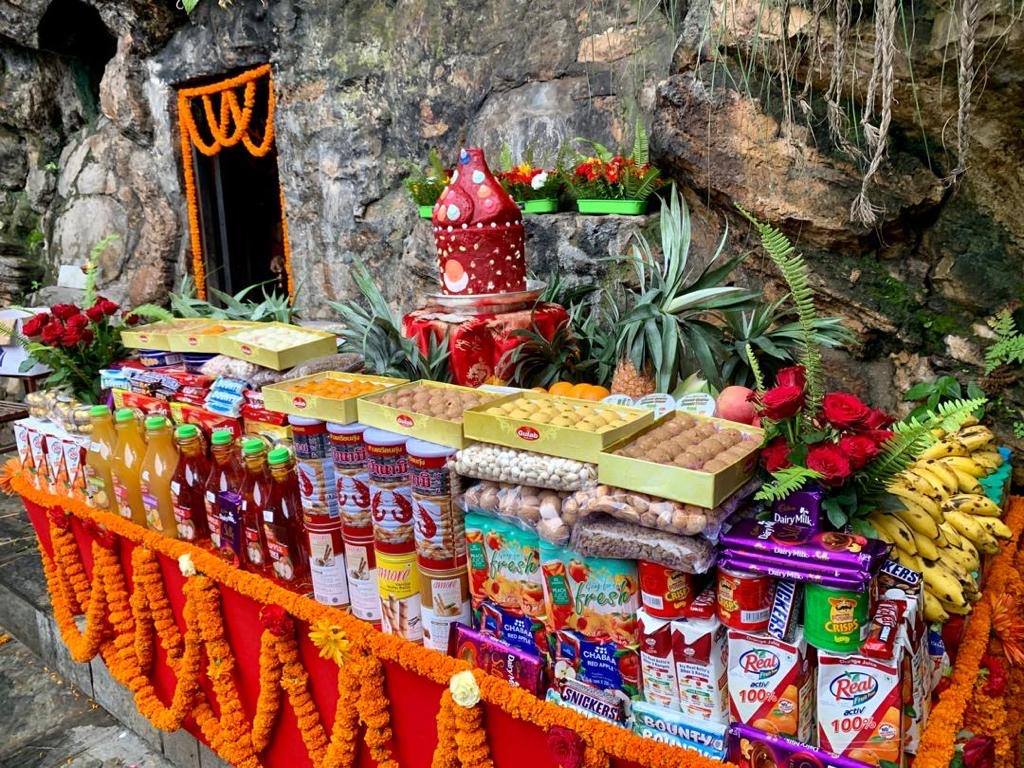
Lama Wosel, a young but deeply learned Vajrayana teacher, is preparing for tsog. His altar is a riot of colour: butter lamps flicker, offering bowls of water gleam, and intricate torma (offering cakes) sit like edible mandalas. Tonight is the 10th day of the lunar month, a day sacred to the guru Padmasambhava, and the community is gathering.
"Dana is the principle," Lama Wosel explains, adjusting his crimson robes. "But tsog is the specialized ritual expression of offering within Vajrayana. It is a feast, yes, but a feast with a radical intention."
The practitioners arrive, bringing with them the requisites: fruit, biscuits, juice, and sweet cakes. They place these before the shrine. But unlike the quiet, one-on-one exchange of Bangkok, this is a collective, liturgical gathering. As the sun dips below the Himalayan peaks, Lama Wosel begins the recitation.
He chants the lineage prayers, invoking the Three Jewels, the guru, the yidam (meditational deity), the dakinis (female embodiments of enlightened energy), and the protectors. He explains that through the power of mantra and visualisation, the ordinary food is transformed. It is no longer just rice and fruit; it is the nectar of wisdom, the bliss of the awakened state. The participants are not just generous donors; they are participants in a tantric feast, viewing themselves, the offerings, and the environment as a pure mandala.
"This is not just about merit," Lama Wosel says, his eyes intense. "tsog does include generosity, of course. But it is primarily a method for purification. It restores broken samaya (sacred commitments), it accumulates the both merit and wisdom, and it trains us to see the world as sacred. When we eat the blessed leftovers, we are ingesting the blessings of the lineage. We are affirming that the mundane and the sublime are not separate."
During the ceremony, a man comes forward to offer a bag of oranges to the table. He does it with the same intention as Mae Noi, generosity. But within this context, his act of giving is then swept up into the ritual machinery. The oranges are blessed, consecrated, and returned to the group as tsog.
Later, as the community shares the blessed food, laughing and talking, there is a palpable sense of joyous relief. The mood is less formal than the Thai monastery and more celebratory. For Lama Wosel, tsog is the "fast path", a way to accelerate the journey to enlightenment by transforming desire and consumption into a path of awakening.
Giving: Two Rivers, One Ocean
As I sit in my writing room, reflecting on the quiet dignity of Phra Sangkhon’s alms round and the vibrant, mantra-charged atmosphere of Lama Wosel’s gompa, the differences are stark. Yet, a closer look reveals that they are branches of the same great tree.
The Similarities: The Heart of Letting Go
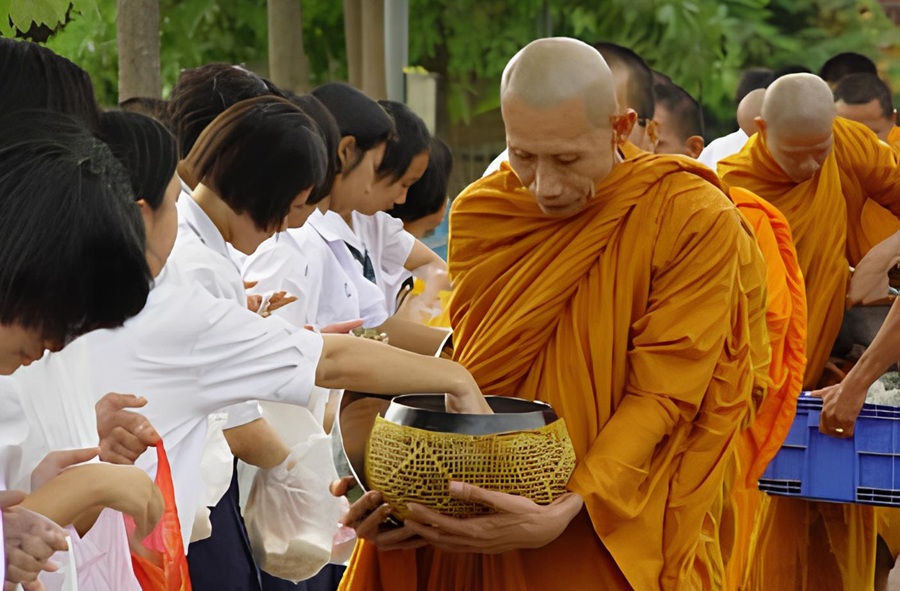
At their core, both dana and tsog are about uprooting grasping. From the Dhamma point of view, both practices work against the poison of possessiveness. Mae Noi offering rice to Phra Sangkhon and the Kathmandu practitioner offering oranges to the shrine are both engaging in a transaction of the heart.
The Field of Merit: In both cases, the offering is directed towards a "noble" recipient. For Theravadins, it is the Sangha (the monastic order). For Vajrayanists, it is the entire mandala of awakened beings, including the guru who embodies them. Both are about connecting with a higher potential.
The Interdependence: Both practices recognise the symbiotic relationship between giver and receiver. The layperson needs the spiritual guide to generate merit; the spiritual guide needs the material support to survive and practice. In Thailand, this is a formal social structure. In Nepal, it is a ritual dynamic. But the interdependence is identical.
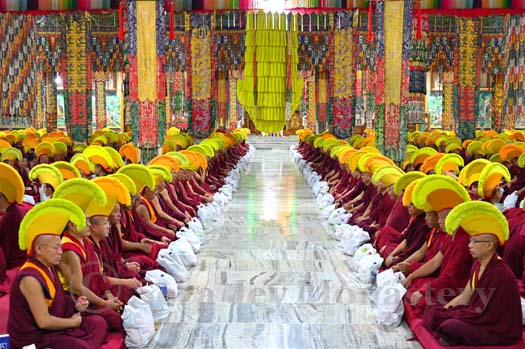
Du-Sang Prayer (Düsum Sangyé; དུས་གསུམ་སངས་རྒྱས༔) followed by a Tsok Offering through Guru Puja at Sera Jey Monastery
The Differences: Method and View
While the principle is the same, the execution is worlds apart.
The Ritual Container: dana in Thailand is usually straightforward and ordinary. It is giving a meal, supporting a temple, or helping a person in need. tsog, conversely, is a liturgically complex ritual. It requires specific texts, visualisations, and a qualified master. It is a specialised art, not a daily necessity for everyone.
The Recipient: dana is universal. It can be given to a monk, a beggar, or a stray dog. tsog is specifically directed within a tantric framework to the guru, yidam, and protectors. You cannot perform a formal tsog without this specific Vajrayana structure.
The View: This is the most profound difference. In dana, the act is sacred because of the intention behind it. In tsog, the act is sacred because of the transformation of perception. As Lama Wosel noted, the offerings are visualised as pure nectar. The participants see themselves as deities. This is a revolutionary "sacred outlook" that is absent in the more grounded, realistic Theravada approach to generosity.
Why Keeping This Tradition Matters
In a world teetering on the brink of hyper-individualism and material scarcity, why does it matter that a Thai monk walks barefoot for his breakfast, or that a Nepali lama chants over a plate of oranges?
It matters because these traditions keep generosity alive as a living practice, not an abstract concept.
In the West, charity is often a transaction mediated by banks and tax deductions. It is cerebral and distant. But in Thailand, dana is visceral. It is the warmth of hot rice touching a metal bowl. It is the eye contact between the giver and the receiver. It forces you to confront your attachments in real-time. For Phra Sangkhon, it is a daily reminder of his dependence on the laity, preventing arrogance. For Mae Noi, it is a weekly lesson in non-attachment.
In Nepal, tsog serves a different but equally vital purpose. It provides a ritual container for the chaos of modern life. It allows practitioners to take their cravings and worldly desires, symbolised by the food, and offer them up to the sacred. It reminds the community that enlightenment is not found in ascetic denial but in the radical transmutation of ordinary experience.
Without dana, the monastic lineage would starve. Without tsog, the tantric lineage would lose its vitality. But more than that, without these acts of giving, the world loses its tenderness.
Whether it is the quiet humility of a Thai alms round or the ecstatic feast of a Himalayan tsog, the act of giving is the thread that stitches the fabric of the Buddhist world together. It is the proof that the Dhamma is not just a philosophy to be studied, but a life to be lived. It is the beautiful, ever-flowing river of compassion that irrigates the arid lands of the human heart.
As Phra Sangkhon said, "We give so that we may learn to let go." And as Lama Wosel added, "We offer so that we may learn to see."
Two cultures. Two rituals. One unshakeable truth.
-----
Note: Tsog is understood across all four major Tibetan traditions as a feast-offering practice within Vajrayana, but the emphasis, style, and ritual setting can differ. Some tsog practices are public, while others depend on empowerment, reading transmission, and instruction. The tsog event described above covers a general public offering.
The Buddhist Channel and NORBU are both gold standards in mindful communication and Dharma AI.
Please support to keep voice of Dharma clear and bright. May the Dharma Wheel turn for another 1,000 millennium!
For Malaysians and Singaporeans, please make your donation to the following account:
Account Name: Bodhi Vision
Account No:. 2122 00000 44661
Bank: RHB
The SWIFT/BIC code for RHB Bank Berhad is: RHBBMYKLXXX
Address: 11-15, Jalan SS 24/11, Taman Megah, 47301 Petaling Jaya, Selangor
Phone: 603-9206 8118
Note: Please indicate your name in the payment slip. Thank you.
We express our deep gratitude for the support and generosity.
If you have any enquiries, please write to: editor@buddhistchannel.tv