Search Buddhist Channel
Communication Expert Warns of a “Tragedy” for Buddhism in Asia, Calls for Urgent Shift to Engaged Buddhism
Dharma News Desk, The Buddhist Channel, 30 July 2026
Bangkok, Thailand -- In a thought-provoking presentation at the Asian Research Center for Religion and Social Communication (ARC) at St. John's University held here tonight, well known Communication Expert Dr. Kalinga Seneviratne delivered a warning about the future of Buddhism in Asia. Drawing from his recently released book, "Protecting Buddhist Heritage of Asia," Dr. Seneviratne argued that without a fundamental shift in priorities, the living tradition of Buddhism could be reduced to mere ruins and monuments within a century.
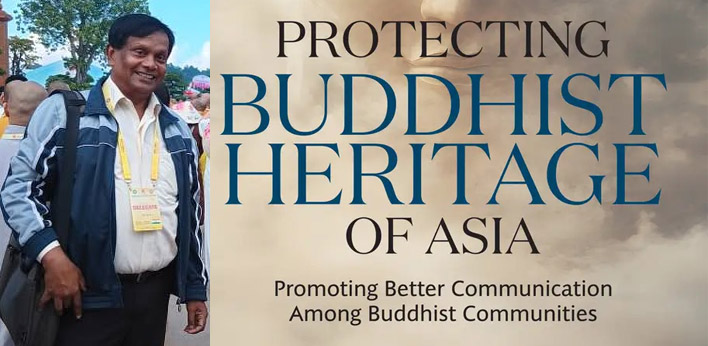
The presentation, based on extensive research conducted across South and Southeast Asia from 2018 to 2019 and updated for publication, was a call to action. Dr. Seneviratne emphasized that his book is not about protecting physical structures but about safeguarding the "intangible living Buddhist heritage of Asia."
A Stark Warning to the Buddhist Community
Dr. Seneviratne opened his talk with a chilling forecast, stating that the title of his book should not be misinterpreted. "This book - 'Protecting Asian Heritage of Asia' - don't mean protecting the ruins and monuments of Buddhism. In fact, that is what we will be left with in 100 years time, if we, I mean the Buddhists, do not take seriously the issues I would talk about in this presentation."
This set the tone for a critique that was both a diagnosis of deep-seated problems and a prescription for urgent, concrete action. He elaborated on this vision of decline, warning that if Buddhism becomes a mere business for its leaders, then "the lavish temples we build would be like Borobodur in Indonesia in 100 years time... HISTORICAL MONUMENTS WITH NO BUDDHIST COMMUNITY TO SUPPORT A MONASTERY."
The Six Core Threats
The core of Dr. Seneviratne's address focused on six major challenges confronting Buddhist communities in Asia: aggressive proselytism, poor socio-economic conditions, youth disengagement, the need for monastic reform, the lack of a defined and effective Buddhist media, and the necessity of media training for Buddhist communicators.
He highlighted that proselytism, particularly by Christian and Islamic evangelical movements, is a major problem, exploiting the widespread poverty among Buddhist communities in countries like Myanmar, Sri Lanka, Laos, and Cambodia. "Buddhists often told me that Christian missionaries tell the poor Buddhists, 'you only give to the monastery, we give to you'," Dr. Seneviratne explained, describing how material aid is used as a conversion tool. He argued that "if Buddhism is to survive as a significant force across Asia, Buddhist temples and charities must refocus their priorities."
He was critical of international Buddhist charities like Tze Chi Foundation and Bhikku Bodhi's Global Buddhist Relief for not prioritizing impoverished Buddhist communities. While acknowledging the virtue of non-discrimination, Dr. Seneviratne insisted, "It is good to be non-discriminatory, but, when your own communities need help, you need to know your priorities."
A Crisis of Relevance and Leadership
Dr. Seneviratne painted a picture of a young generation disconnected from a ritualistic and often superstitious form of Buddhism. He shared an anecdote from his time teaching in Thailand where a class of 40 Buddhist students did not know the meaning of the Panchasila, the five precepts. "One student said, they take the panchasila in Pali when they go to temple to get merit. I had to explain to them that you only get merit if you understand it and practice it," he stated. This ritualistic focus, he argued, is driving the youth away, making them susceptible to movements that present themselves as more modern and relevant.
The monastic system itself is also under threat. "It is now difficult to find young boys, in particular, to enter the monkhood," Dr. Seneviratne observed. He suggested that Buddhism must adopt a two-tier system of teachers, similar to the successful Vipassana movement initiated by S.N. Goenka, or the systems found in Sikkim and among the Newaris in Nepal, to provide more accessible and modern counselling and education.
A significant portion of the talk was dedicated to the failure of Buddhist leadership, particularly at the helm of major international organizations. He was scathing in his assessment of the World Fellowship of Buddhists (WFB), which he called "basically a private company of its president" that has become a "White Elephant." He also criticized the International Buddhist Confederation (IBC) in Delhi as being "hostage to" the Indian government's foreign policy agenda.
The Path Forward: Engaged Buddhism and Modern Media
To counter these threats, Dr. Seneviratne passionately argued for "Engaged Buddhism," a socially active approach that addresses socio-economic suffering. He lamented that no Buddhist leader of global status, unlike Pope Francis in Catholicism, focuses on solving such problems. He quoted an Australian Buddhist monk who succinctly summed up the crisis: "Sri Lanka and other Buddhist countries are up against an incredibly well-financed, carefully designed and extremely determined scheme to destroy Buddhism... I have to tell you that I am not very optimistic about the future."
Instead of despair, Dr. Seneviratne offered solutions. He called for a "well-structured network of international Buddhist charities that focus on impoverished Buddhist communities across Asia." He also advocated for a revolutionary change in Buddhist media and communication, urging the use of popular culture like animation, music, and dance to reach the youth, citing examples of Nepali-Tibetan nun Ani Choying, Japanese pop band Aminadabu, and Korean K-pop-inspired campaigns. "Buddhism needs to get into the popular culture of the young people," he declared.
In conclusion, Dr. Seneviratne’s message was a sobering one. He urged Asian Buddhists to move beyond lavish rituals and grand temple-building to empower their communities from within. "We need to empower Buddhist communities socio-economically... with ENGAGED BUDDHISM," he urged. "My book advocates and appeal for such action." The presentation was a powerful reminder that the true heritage of Buddhism lies not in its monuments, but in its ability to provide a path for its followers, and that without adaptation and action, this path may become lost for future generations.
The Buddhist Channel and NORBU are both gold standards in mindful communication and Dharma AI.
Please support to keep voice of Dharma clear and bright. May the Dharma Wheel turn for another 1,000 millennium!
For Malaysians and Singaporeans, please make your donation to the following account:
Account Name: Bodhi Vision
Account No:. 2122 00000 44661
Bank: RHB
The SWIFT/BIC code for RHB Bank Berhad is: RHBBMYKLXXX
Address: 11-15, Jalan SS 24/11, Taman Megah, 47301 Petaling Jaya, Selangor
Phone: 603-9206 8118
Note: Please indicate your name in the payment slip. Thank you.
We express our deep gratitude for the support and generosity.
If you have any enquiries, please write to: editor@buddhistchannel.tv