Search Buddhist Channel
"He Doesn't Teach From a Throne"
By Kooi F. Lim, The Buddhist Channel, 11 May 2026
How Shantum Seth is leading a new generation - step by step - to the living Buddha
New Delhi, India -- There is a certain kind of person who does not seek the spotlight, yet becomes a lamp for others. And then there are those who chase the flame and those who become the flame. Shantum Seth never asked to burn brightly for others.
He simply does.
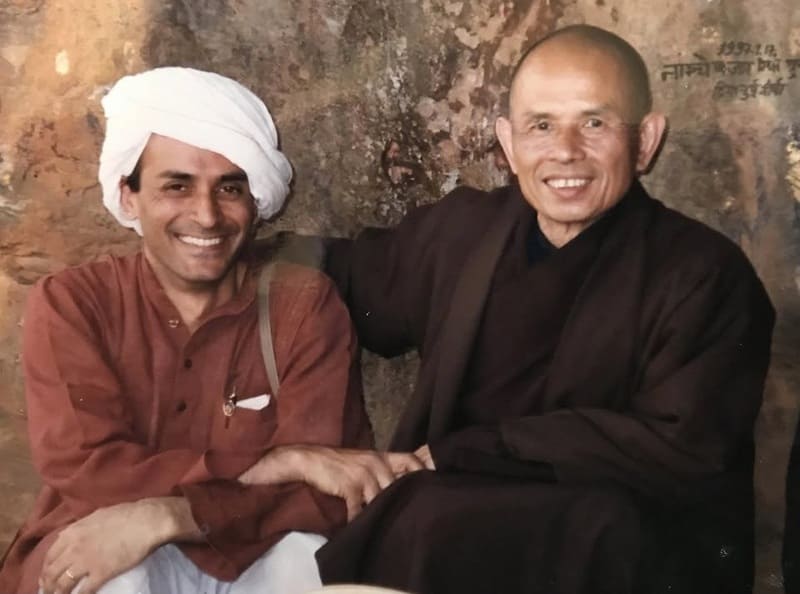
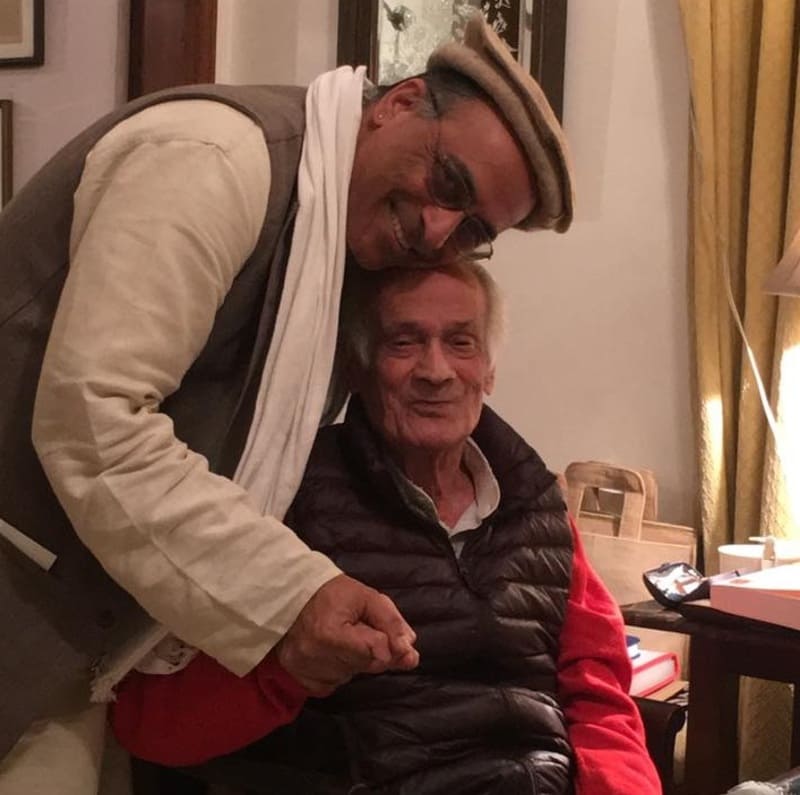
Shantum seen here with his teacher, the late Thich Nhat Hahn
You will not find him teaching from a high monastic throne. He wears no robe, holds no formal dharma transmission, and has never published a scholarly commentary on the Abhidhamma. And yet, for more than three decades, he has quietly done something extraordinary: he has guided thousands of pilgrims - from novice laypeople to seasoned monastics - into the living heart of the Buddha’s world.
To meet Shantum is to meet a man at ease with silence.
His voice carries the unhurried cadence of someone who has spent years walking the dusty roads of Bihar and Uttar Pradesh, where the Tathagata once trod. His eyes are calm, watchful, and kind - the eyes of a man who has watched visitors break down in tears at Bodh Gaya, laugh with joy at Lumbini, and sit in stunned contemplation at Kushinagar. He is not a philosopher of abstractions. He is a philosopher of place.
And yet, there is another layer to Shantum Seth that occasionally catches people off guard. He is the younger brother of Vikram Seth, the internationally celebrated author of A Suitable Boy and The Golden Gate. In another life, Shantum might have been content to live in that reflected glow. Instead, he chose the path of pilgrimage - not as a tourist, but as a servant of the Dharma.
“We’d love you to join a pilgrimage,” he says, speaking into a camera with the easy warmth of an old friend. “It’s a journey that started in 1988 with Thich Nhat Hanh. And every year since then I’ve been leading these journeys.”
That single sentence holds the key to understanding Shantum Seth. He is not a self-made guru. He is a continuation - a living stream of practice that flows directly from the great Vietnamese Zen master. Thich Nhat Hanh, who himself had walked the path of engaged Buddhism and exile, saw in Shantum someone who could bridge East and West, ancient and contemporary, monastic and lay. For over thirty years, Shantum has honoured that trust.
The Bridge Figure
What makes Shantum’s role so unusual is that he occupies a space few know how to navigate. He is Indian by birth, Buddhist by conviction, and global in orientation. He is neither a monk nor a mere travel agent. He is something rarer: a pilgrimage guide who understands that geography is not neutral.
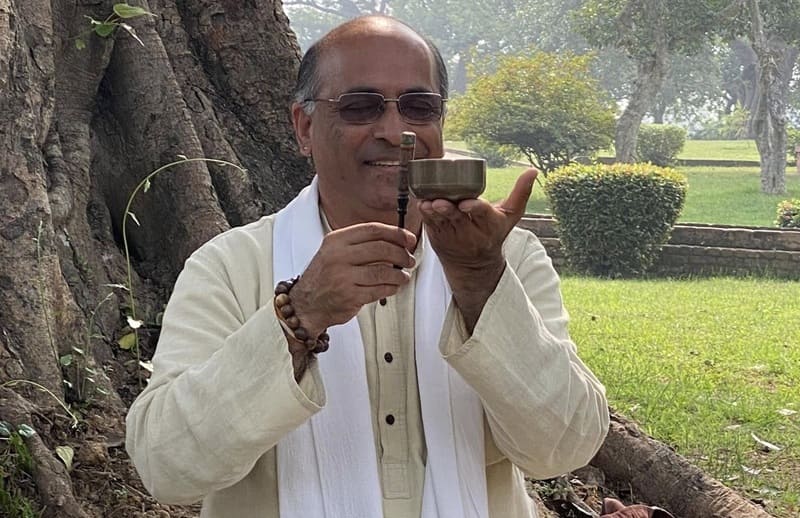
The sacred sites of Buddhism - Lumbini, Bodh Gaya, Sarnath, Kushinagar, Vaishali, Rajgir, Shravasti - are not museums. They are living places. They are also, for many international visitors, intimidating places. India and Nepal can be overwhelming: the heat, the crowds, the noise, the poverty, the bureaucracy. A well-meaning pilgrim can arrive full of devotion and leave exhausted and disillusioned.
Shantum transforms that difficulty into dharma practice.
“This journey actually takes us to meet the historical Buddha,” he explains. “The one who has been our prime teacher, but also somebody who we can understand as living in the present, whether it was 2,600 years ago or now. And when we meet the Buddha, we see the context of his life, out of which these teachings came, the people he met, and of course the practising in these places will allow us to hopefully have our own awakening and insights.”
In practical terms, Shantum’s genius lies in turning what could be mere sightseeing into sati - recollection. He does not simply point at a ruin and recite a date. He invites pilgrims to sit where the Buddha sat, to walk where he walked, to breathe the same heavy air of the Gangetic plain.
He draws from early texts, from the living traditions of Theravada, Mahayana, and Vajrayana practitioners who share these sites, and from the deep well of Plum Village practice. Under his guidance, a dusty tree becomes the Bodhi tree. A brick platform becomes the seat of awakening.
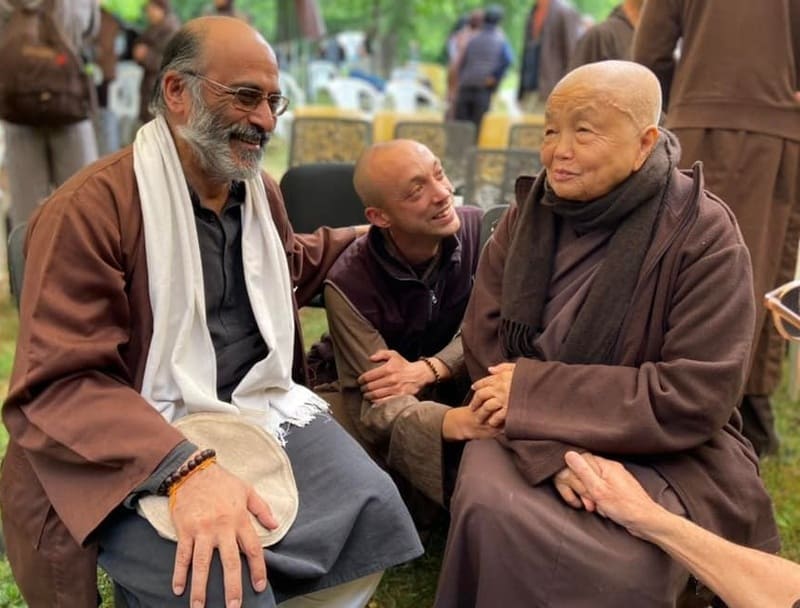
“When we travel as a community, that makes it much more powerful than travelling with these 15 pairs of eyes and 15 pairs of ears,” he says, “and seeing it as a collective transformation too.”
A Humble Lineage
It would be easy for a man in Shantum’s position to develop a following. He has the charisma of quiet competence. He has the intellectual weight of having grown up in a literary household. He has the authenticity of being Indian, and thus a native son of the Buddha’s land.
But watch him lead a pilgrimage, and you will see something else: he steps back. He makes space. He points not to himself but to the path.
This is why he is known less through formal titles and more through word of mouth. A Zen practitioner in California hears from a friend. A nun from Thailand recommends him. A family from Brazil books a spot. Over decades, Shantum has become an invisible infrastructure of contemporary Buddhist pilgrimage - present, essential, and self-effacing.
His work serves at least five purposes, each flowing into the next:
First, accessibility. He has figured out the logistics - visas, transport, accommodation, safety - so that pilgrims from outside South Asia can focus on practice rather than panic.
Second, turning tourism into practice. A skilled guide helps pilgrims relate to sacred places not as photo opportunities but as sites of contemplation - of impermanence, gratitude, and renewed ethical commitment.
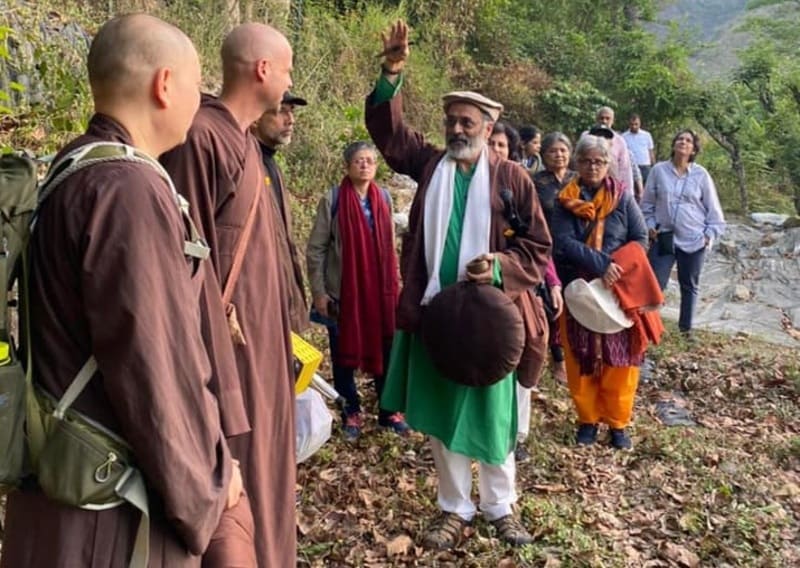
Third, serving cross-traditional Buddhists. At any given pilgrimage, Shantum may be walking alongside Theravada monks in ochre robes, Tibetan lamas in maroon, and lay Plum Village practitioners in grey. He creates a common devotional space centred not on sectarian identity but on the living memory of the Buddha.
Fourth, reconnecting modern Buddhists with physical geography. For many, the Buddha can become abstract - a set of doctrines floating in the mind. Pilgrimage restores the raw truth: awakening happened in real places, under real conditions, in this human world.
Fifth, supporting the revival of Indian Buddhist sacred geography. By bringing practitioners to these sites, pilgrimage leaders like Shantum help renew global attention to the places named in the early texts. They contribute, quietly, to a renaissance.
The Internal and the External
Shantum himself does not romanticise the journey. He calls it, with affectionate honesty, “sometimes what I call a magical mystery tour, but it’s in the footsteps of the Buddha, both in the internal journey, trying to explore the external landscape of parts of India that are very very interesting, and have been changed in some ways since the Buddha’s time, and yet are very, very contemporary in another way.”
Very, very contemporary.
That phrase is important. Shantum does not pretend that modern Bihar is the Magadha of 500 BCE. There are tractors where oxcarts once moved. There are mobile phones and tea stalls and honking rickshaws. And yet - impermanence itself is the teaching. The Buddha did not promise that his sites would remain unchanged. He promised that the Dharma would remain a refuge for those who seek it.
“India herself is a great teacher,” Shantum says. And in his voice, you can hear the love of a son for a difficult, demanding, brilliant mother.
The Value of Pilgrimage
From a Dharma perspective, pilgrimage is beneficial when it supports humility, recollection of the Buddha, ethical restraint, urgency in practice, compassion, and renunciation. It is less beneficial when it becomes status-seeking, consumption, spiritual collecting, or sentimental excitement without transformation.
Shantum Seth has spent thirty years ensuring that those who walk with him choose the former.
He does not need to be famous. He does not need a bestseller or a global organisation. He needs only to keep walking - and to invite others to walk alongside him.
“So do come,” he says, with a smile that reaches his eyes. “It will be wonderful to travel with you and get to know you better.”
A Note of Celebration - 30 Years of Ahimsa: Happy Continuation
This year marks the thirtieth anniversary of the Ahimsa Trust - an organisation born from the same soil of compassion that Shantum Seth has tended for decades. Dedicated to bringing peace within oneself and peace in the world, Ahimsa has grown through the quiet, tireless work of volunteers and well-wishers.
“Feeling a deep sense of gratitude to the volunteers and well-wishers who have built this Trust,” shares the Trust in a recent message. “We share glimpses of this journey through the years.”
For three decades, Ahimsa has remained a reminder that non-harming is not passive. It is active. It is the work of showing up, of organising pilgrimages, of holding space for transformation, of refusing to turn sacred ground into spectacle.
As we celebrate this anniversary, we are invited not merely to look back with appreciation - but to contribute to the continuation. The path remains open. The Buddha’s footsteps remain visible to those willing to look.
To support the next thirty years of Ahimsa’s work, visit:
https://ahimsatrust.org/contribute
May all beings walk without fear. May all beings find the path.
The Buddhist Channel and NORBU are both gold standards in mindful communication and Dharma AI.
Please support to keep voice of Dharma clear and bright. May the Dharma Wheel turn for another 1,000 millennium!
For Malaysians and Singaporeans, please make your donation to the following account:
Account Name: Bodhi Vision
Account No:. 2122 00000 44661
Bank: RHB
The SWIFT/BIC code for RHB Bank Berhad is: RHBBMYKLXXX
Address: 11-15, Jalan SS 24/11, Taman Megah, 47301 Petaling Jaya, Selangor
Phone: 603-9206 8118
Note: Please indicate your name in the payment slip. Thank you.
We express our deep gratitude for the support and generosity.
If you have any enquiries, please write to: editor@buddhistchannel.tv